
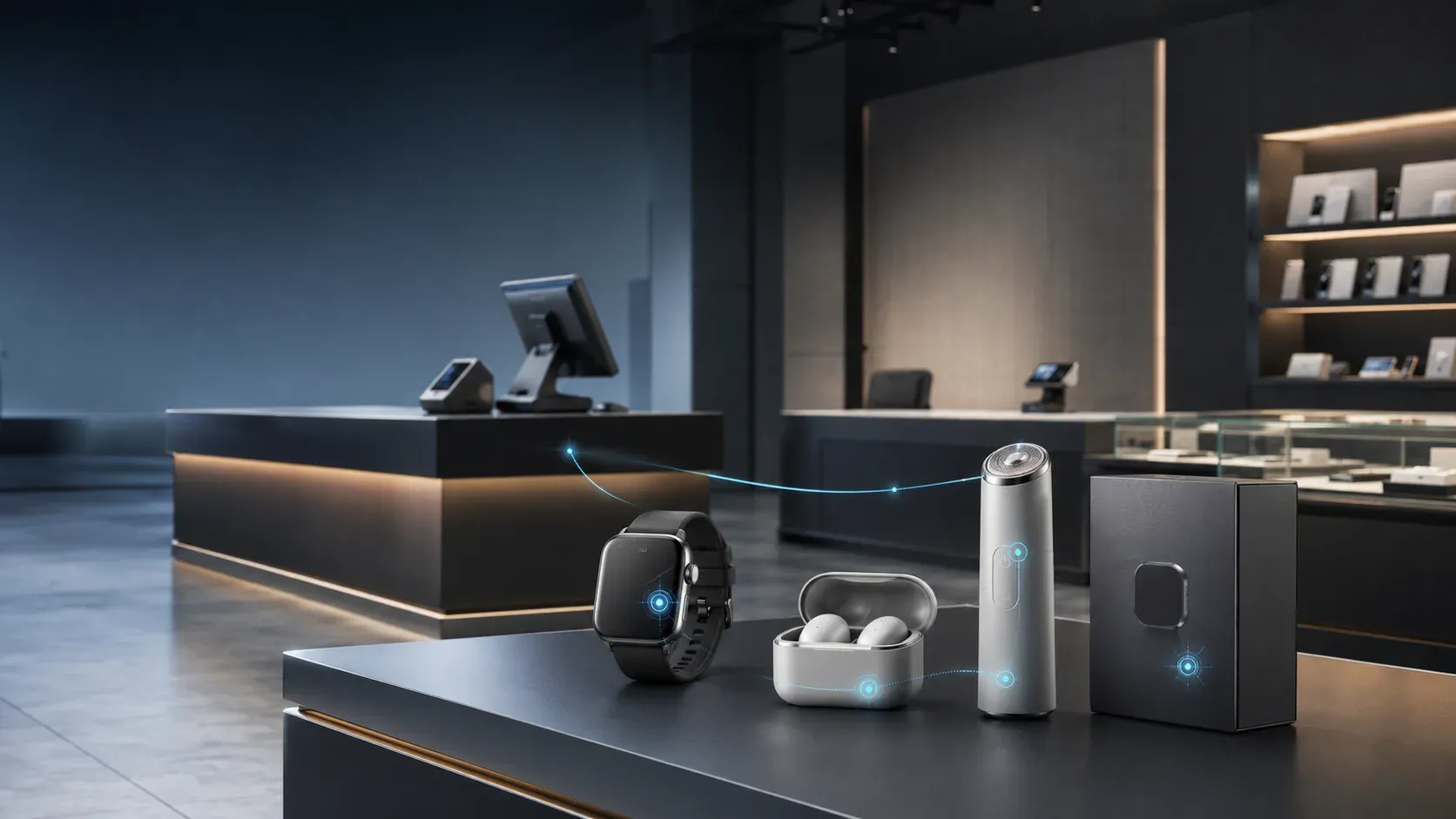
A flagship store can quickly take payment, issue an invoice and hand over a wearable device. Months later, another store may still need to reconstruct the receipt, serial number, purchase date and selling location before accepting a service request. Recording a sale is not enough if the actual item was never linked to the order, customer and store.
Wearables, audio products and personal-care electronics often have device identifiers, higher unit values and long service lives. Retail selection should therefore connect flagship transactions, item-level identity and after-sales intake as one continuing record.
Connect the same item across retail and service
A SKU answers how many units of a model remain. A serial number or unique identifier also distinguishes which unit, where it is, its status and its history. Receipt establishes store inventory; transfers change location; POS links the item to a sale; returns and service reuse that identity.
| Stage | Question | Records |
|---|---|---|
| Receipt and transfer | Where did the item arrive and move? | Unique ID, SKU, store, document, time and state |
| Display | Is it saleable, a demonstration unit or awaiting inspection? | ID, stock type, change and reason |
| Sale | Which unit was handed over? | ID, order, store, customer and time |
| Exchange | What was returned and what replaced it? | Original and replacement IDs, sale and processing documents |
| Service intake | Which item and sale does the request concern? | ID, purchase record, issue, accepting store and progress |
Scanning is only a collection method. Continuing use of the identity and recorded state changes create the history.
Bind flagship sales to the device actually delivered
Flagship transactions can combine devices, accessories, gifts, reservations, invoices and payment methods. For individually tracked goods, POS must also confirm the exact device. Deducting a SKU quantity without checking the serial number leaves a gap for returns, repairs and channel enquiries.
Ask suppliers to select an item, scan or enter its ID, validate saleable stock, take payment and generate the transaction. Then query the item and verify its order, store and status. Test one order containing a serialised device and a quantity-managed accessory.
The PEKON Smart Retail System covers store POS, products, stock, orders, returns and operating data; product material also identifies unique codes as an inventory dimension. Confirm configuration against the brand’s coding, store workflows and existing systems rather than treating all products identically.
Record events and choose the right tracking granularity
Two devices can share a SKU but have different serial numbers. A unique ID does not itself create a complete history: receipts, transfers, display, sales, returns and service must continue to reference it.
Choose barcodes, QR codes or RFID based on existing identifiers, hardware, efficiency and scope. Item-level tracking does not require a new QR label or replacement of manufacturing serial numbers. Define who creates codes, how retail receives them, where they are captured and how invalid, duplicate or unreadable codes are handled.
High-value devices and goods with warranty or replacement requirements often justify instance-level records. Low-value cables or cases may remain quantity-managed where individual tracking is unnecessary. Create a product-type matrix and test both methods.
Location and responsibility differences can provide leads for channel investigations, but records alone do not automatically establish unauthorised distribution. Apply channel policy and actual business context.
Reuse the original identity for after-sales intake
A service request should identify the device, original sale, accepting store or service point and current physical state. Retrieving purchase time, store and prior handling reduces repeated questioning and entry, particularly across stores.
Returns, exchanges and replacements must preserve relationships between original and new devices. PEKON’s consumer electronics solution describes store-side service registration, serial-number records and integration with separate service systems.
Agree the boundary: retail POS or a WeChat mini-program may support intake and purchase verification, while a specialist after-sales system owns inspection, repair dispatch, service networks, spare parts, charges and settlement. Exchange agreed fields and states rather than duplicating complete work-order systems.
Distinguish stock status from physical presence
Demonstration units, returns awaiting inspection, devices awaiting repair and goods in transit are not equivalent to saleable stock. Configure stock types or logical locations and preserve documents and reasons for state changes.
Test a saleable unit becoming a display unit, a return entering inspection, a service item entering pending handling, and the subsequent return to sale or exit from inventory. This is store stock-state management, not a replacement for WMS or full repair-parts management.
Demonstrate one continuous item journey
Prepare a serialised device, a normal accessory, two stores, a demonstration unit, a transfer and a replacement request. Ask the supplier to:
- Define item-level versus SKU rules and the code source.
- Receive a device and link SKU, unique ID, store, receipt and status.
- Convert an item to display and separate it from availability.
- Transfer from Store A to Store B, retaining dispatch, transit and receipt confirmations.
- Sell a serialised device and normal accessory together with correct deductions.
- Trace the item to the order and the order to the delivered item.
- Register service at another store with original-sale identification and appropriate permissions.
- Replace the device while linking old and new IDs and documents.
- Explain service-system fields, state ownership, failure recovery and reconciliation.
- Show store, region and headquarters access and audit records.
Judge identity continuity, timely state changes, detectable exceptions, replacement relationships and clear ownership. These are more useful than isolated POS, scanning and ticket demonstrations.
Frequently asked questions
How does this differ from ordinary POS?
Brands with serial, warranty or replacement requirements need identity to continue through inventory, sales, returns and service, with clear enterprise-system boundaries.
Does every electronics product need a unique code?
No. Consider value, warranty, channel checks, returns and management cost. Some accessories can remain SKU-and-quantity managed.
Must the code be a QR code?
No. It describes identity, not the carrier. Barcodes, QR codes or RFID may be appropriate.
Why register service in retail if a service system exists?
Retail can own intake, identity and purchase checks while the specialist system handles inspection, repairs, parts and settlement. Confirm fields and responsibilities before implementation.
How should display, returned and service-pending devices be managed?
Use distinct stock types or logical locations, with controlled transitions, reasons and audit records. Physical presence must not automatically imply availability.
Choose the system by tracing identity continuity
Map a representative product from receipt through display, transfer, sale and service or replacement. At every step, name the actor, data, state change, responsible system and handover to the next step. Use that map and PEKON’s consumer electronics retail solution to evaluate scope against product types, store formats, service policy and existing systems.