Judgment, evaluation and real projects for retail system selection · organized by industry
Drawing on PEKON's product capabilities and long-standing experience serving retail brands, these topics bring together the key questions and practical approaches behind retail digital transformation.
Explore how business coverage, industry fit, system integration, migration, and continuous evolution shape a retail platform that can support the next three to five years of brand growth.
Explore topic →Build a dedicated digital operations platform spanning stores, customers, channels and consumer engagement on a foundation of proven products.
Explore topic →Connect headquarters standards with local market operations, and turn each country rollout into a repeatable regional capability.
Explore topic →
Different promotions serve different business purposes, so effectiveness cannot be judged by order growth alone. This article uses simplified examples to explain how brands can evaluate sales, gross margin and promotional investment, while using promotion rules, discount calculations and transaction records to support future adjustments.
Read more →
Track returned devices by serial number, preserve activation history, and separate inspection stock from devices approved for a defined sales use.
Read more →
Bring customer, product and inventory information to luxury sales associates, with role-based access that supports service, sales and staff handovers.
Read more →
Separate saleable stock from returned devices awaiting inspection, repair or a decision, with clear ownership and next steps for each inventory group.
Read more →
This article explains how beauty brands can identify the right time to re-engage members by combining purchase intervals, product usage cycles, member value, and engagement behavior. Instead of relying on broad promotional campaigns, brands can use customer data to deliver timely, personalized reminders and service follow-ups, helping improve repeat purchases, member relationships, and long-term loyalty.
Read more →
This article explains how beauty brands can combine Product ABC and Store ABC classifications to create more differentiated replenishment standards. By identifying priority products, grouping stores according to sales scale, and applying corresponding ordering rules, brands can protect bestselling items, control slow-moving inventory, and adapt quantities to each store’s actual demand. PEKON’s replenishment and inventory optimization solution supports classification tags, differentiated parameters, quantity calculations, simulations, and store-level adjustments.
Read more →
Before a mobile POS sale, luxury retail teams confirm customer identity, product availability, pricing, delivery arrangements, and staff permissions.
Read more →
When a customer cannot see a coupon, first establish whether they are viewing their coupon wallet or offers eligible for the current purchase. Retail teams can then check member identity, coupon status, and store and order eligibility. This guide explains how beauty brands can connect CRM records with POS transaction rules to give customers clear answers and route unresolved questions to the right team.
Read more →
After claiming a coupon online, customers expect to use it clearly and smoothly when they visit a store. Brands need to connect campaign descriptions, coupon eligibility checks, and redemption records so that headquarters rules are applied consistently at checkout. PEKON connects CRM, mini-programs, and POS to associate member identities, coupons, and transaction records.
Read more →
In-store gift set assembly helps trendy toy stores respond to customers’ theme and budget needs. By defining eligible products, pricing rules, and operating permissions, brands can retain both bundle and component transaction records while keeping store-level flexibility aligned with headquarters’ product management. PEKON supports temporary bundle sales through POS, component inventory deduction, and the connection of component sales, settlement data, and ERP according to the integration plan.
Read more →
After a dealer submits an order, the company must verify funds, inventory, applicable quotas, and any additional gifts. Once approval is completed and payment or order confirmation is finished, the order can move into allocation, picking, and shipment.
Read more →
After a store creates a temporary bundle, headquarters does not necessarily need to create an identical product in ERP. Whether the bundle master data should be synchronized depends on whether ERP needs to support long-term sales, purchasing, accounting, or inventory management for the bundle. Sales and component inventory results should be returned according to the agreed interface responsibilities.
Read more →
Birthday benefits, replenishment reminders and product launches can reach the same member while a store associate is also planning a conversation. For beauty brands operating in China, campaign coordination needs shared contact records, clear priorities and an agreed division of work between HQ automation and store teams. This article explains when to combine or defer contact, how to assign ownership, and which reminders should stop after a purchase, benefit claim or refusal. It also outlines connected scenarios for evaluating a member management system.
Read more →
A partially shipped order may reflect agreed phased deliveries, different product supply schedules or temporary stock shortages. Brands can manage the remaining items under the order terms, agreeing with dealers whether to retain items for later dispatch, change them or cancel eligible quantities. Each decision needs to correspond to warehouse execution and account records. PEKON B2B Ordering provides a foundation for ordering, approval and allocation, and account management, with ERP coordination shaped around the brand’s policies and project requirements.
Read more →
Centralized cloud management combined with local terminal transactions is becoming an important direction in retail system evolution. High transaction volume should be treated as an acceptance requirement, not as a standalone reason to retain dedicated store servers. This article explains why brands should reassess existing architectures from the perspectives of deployment, store expansion and long-term maintenance, and outlines the value of PEKON’s hybrid terminal model.
Read more →
An important shift in light beauty care franchising is the way headquarters and stores organize their respective responsibilities. Headquarters focuses on the brand, customer acquisition and products, while stores focus on care services and customer relationships. Online acquisition, in-store experiences and at-home product purchases can be connected, extending the value of franchise cooperation from opening a store to ongoing operations.
Read more →
Member data compliance involves processing bases, notice and consent, information usage, benefit rules, account closure, data retention and operational audits. This article explains how a membership system turns brand policies and governance requirements into searchable, controllable and traceable business records.
Read more →
This article explores how 3C retail systems support consumer electronics pre-orders, from advance payments and inventory allocation to balance collection and in-store pickup. It explains how brands can connect pre-orders, payment records, product serial numbers, and completed sales while managing overdue pickups, cancellations, and inventory releases. It also outlines key considerations for evaluating system capabilities and coordinating retail operations with existing ERP and financial systems.
Read more →
China store systems must support global headquarters, China operations teams, and daily store workflows. This article explains how products and pricing, access permissions, sales and inventory, member services, and exception handling connect those roles, alongside the existing framework for data security, headquarters access, system integration, project validation, and ongoing support.
Read more →
A sports and footwear exchange is not simply a matter of replacing one item with another. Stores need to start from the original sales order, accurately record the returned and replacement style-color-size SKUs, support equal-value exchanges, and collect any price difference when a higher-priced item is selected.
Read more →
The PEKON retail system handles store sales, returns and exchanges, store inventory operations and payment result records, while exchanging relevant business data with ERP, OMS, WMS and CRM. Using a beauty store sale and a partial return as an example, this article explains the typical responsibilities of each system, the records that connect them, and the data boundaries brands need to agree during implementation. It also covers online order handoffs, recovery after interface interruptions and acceptance tests for both normal transactions and incomplete processing.
Read more →
The PEKON Smart Retail System uses price lists to manage product base prices and their applicable scopes. Brands can configure different price lists for regions, stores, counters, channels, or markets, while member benefits, promotions, mall discounts, and store-level price changes are calculated and recorded separately.
Read more →
A luxury product reservation should connect the customer, product, payment, fulfillment store, and reservation period in one business record. Deposits and inventory holds should be recorded separately, while inter-store transfers should change the product location without breaking the original reservation relationship.
Read more →
A cosmetics recall requires more than stopping sales. Brands need to identify affected batches, suspend sales at stores, isolate physical products, trace related orders, process customer returns, and reconcile final handling results. This article explains how a connected retail system can link batch inventory, store transactions, order records, and recall statuses to support clearer execution and more reliable reporting.
Read more →
Beauty Advisor performance calculation depends on accurate records of transactions, product lines, service roles, store assignments, returns, and manual adjustments. This article explains how a beauty store POS system preserves transaction-time data, supports multi-person and cross-store attribution, links returns to original orders, and provides traceable details for performance calculation and commission reconciliation.
Read more →
A beauty pop-up store operates for a limited period, so store setup, device deployment, temporary staff permissions, promotional products, and inventory transfers must be completed together. The POS system should also preserve member, payment, refund, inventory, and after-sales records after the pop-up store closes.
Read more →
Building an APAC multi-country retail system starts with a clear division of responsibilities between headquarters, the regional platform and local stores. PEKON explains how to connect ERP, CRM and BI systems, maintain shared product and transaction definitions, and turn country-specific payments, invoicing, languages and support into reusable configurations, interfaces and rollout materials.
Read more →
For the first APAC stores, brands need to compare extending a global retail system, appointing a vendor in each country and adopting a regional platform. PEKON explains how country-level localization costs, headquarters data standards, integration scope and local support shape that choice, and which responsibilities should be agreed before rollout.
Read more →
Retail system localization costs in APAC extend beyond software licenses. PEKON explains how payments, tax, language, testing, training and local support shape country-level investment, store rollout costs and ongoing maintenance.
Read more →
Malaysia electronic invoicing is a store operations issue as well as a finance requirement. A retail POS must connect sales, buyer information, invoice validation and subsequent returns without confusing a successful sale with a validated invoice. This article explains the three main retail scenarios, the transaction and status records that need to move between systems, and the responsibilities to agree with a local service provider. It also describes PEKON’s ongoing Malaysia integration project and the end-to-end demonstration retailers should request before accepting an implementation.
Read more →
Multilingual retail systems can support local stores and regional headquarters within the same platform. Using Indonesian store operations as a starting point, this article follows language coverage through product setup, receiving, checkout and returns, showing why shared records matter alongside familiar interfaces. It also explains how to define terminology review, acceptance testing and ongoing support, and draws on PEKON’s Chinese iPad POS and English web back-office delivery for a premium chocolate brand entering China.
Read more →
For a retail brand entering Japan, consumption tax compliance reaches beyond selecting a tax rate. The legal issuer, receipt fields, mixed-rate baskets, discount allocation, rounding and returns all affect the POS design. This guide explains how a qualified simplified invoice can be issued through a retail receipt, which decisions local finance must approve, and what a retailer should test before store launch. It also separates current operating rules from proposed tax changes, and identifies the boundary between standard retail configuration and project-specific integration.
Read more →
A dealer portal can show several balances while still making month-end reconciliation difficult. Prepayments, rebates, campaign support and materials allowances do not have the same financial meaning, and a single available-balance figure can hide reservations or restricted funds. This article sets out the ledger structure, a worked reconciliation example, return and cancellation rules, and the responsibilities of the B2B platform and ERP. It also provides acceptance tests for duplicate messages, insufficient rebate balances, cross-period adjustments and other situations that determine whether an account can actually be explained.
Read more →
For an international brand opening its first store in China, a successful payment is only one part of the transaction. The retail order, payment record, tax invoice and financial posting can reach completion at different times. This guide explains which rules to agree before integration, how a mixed-payment sale and partial return should be traced, and what happens when an invoice request times out or a refund arrives before an invoice result. It provides practical acceptance tests for the local store layer and its connection to headquarters.
Read more →
A successful refund does not prove that a loyalty return is complete. Redeemed points may need restoring, newly earned points may need reversing, coupons may be eligible for reinstatement, and tier qualification may change. Using a worked example, this article separates those movements and explains which records the POS, payment service and CRM should own. It also covers partial returns, expired benefits, insufficient points, delayed messages and the acceptance evidence needed to show that a transaction has been reconciled across systems.
Read more →
For brands operating distributor networks, a correct order total is only the start. Pricing, promotional free goods, rebate accruals and credit checks must remain traceable when quantities change, deliveries are split or goods are returned. This guide uses one worked example in Chinese yuan to define eight acceptance tests for a B2B ordering rules engine. It explains the expected calculations, evidence to retain and responsibilities to agree across the ordering platform, ERP, warehouse and finance systems.
Read more →
Moving from spreadsheets or a legacy ordering portal involves more than importing records. International brands operating distributor networks in China need stable distributor identities, executable price rules and a clear handover for orders still awaiting approval, payment or shipment. This guide explains the migration sequence, treatment of account balances and payment records, and checks needed to prevent incorrect pricing, duplicate collections and repeat shipments. A worked example shows how a partially shipped order should retain its original commercial terms after cutover.
Read more →
A CRM can link several identifiers and still make the wrong membership decision. Phone numbers can be shared or reassigned, WeChat identifiers have specific scopes, and duplicate cards can enter through imports. This guide provides ten proof-of-concept cases for OneID, from registration and phone changes to account merging and correction after new transactions. It defines the evidence to retain, the benefits rules to agree beforehand, and the limits of automatic matching so that a successful demonstration can be judged against a repeatable acceptance baseline.
Read more →
In department store concession operations where malls collect customer payments, brand sales, commission bases, concession deductions, promotional expenses, settlement amounts, and actual bank receipts represent different records. This article uses a calculation example to explain how brands can reconcile POS sales, promotional transactions, refunds, and cross-period adjustments against mall settlement statements.
Read more →
A POS that can record a sale during a network outage may still be unable to authorize a payment, redeem a coupon or check a live member balance. For international brands operating stores in China, acceptance testing needs to separate local sales capture, payment confirmation and recovery synchronization. This guide uses a CNY 220 transaction to test uncertain payment results, repeated uploads, inventory conflicts and loyalty updates. It also explains how store procedures and system responsibilities help preserve the original transaction when connectivity returns.
Read more →
A retail system does not need replacing simply because it is old. The stronger warning is that recurring failures, unreliable data and manual workarounds have become part of daily operations. This article sets out six business signals that justify a formal assessment, from interrupted transactions and inconsistent loyalty records to slow change, scaling problems and maintenance risk. It explains how to compare repairs, partial replacement and full renewal, what evidence to collect before selecting a vendor, and why real exception scenarios are more useful than a generic product demonstration.
Read more →
A collectible toy brand may accept preorders while products are still in production or transit. The quantity promised to customers is a commitment against future supply, not stock already available in a warehouse. This article explains how to approve preorder quotas, reserve them for orders, and convert valid commitments into physical allocations after receiving and quality checks. Worked examples show why split deliveries and shortages need to be tracked by payment status and promised collection date. Six acceptance tests help teams check the handoff between retail, order management and warehouse systems.
Read more →
When a department store collects payment but a brand enters the sale later, changing the transaction date is only part of the work. The original trading date, actual entry time and inventory posting time need separate records. This article explains how to reconcile receipts, avoid duplicate charges and stock deductions, and handle daily closing or locked accounting periods. A worked example and acceptance checklist help brands test the process without assuming that every historical adjustment is a standard POS feature.
Read more →
Should your brand adapt its global POS for China or replace the local store system? Learn how to assess operational gaps, define responsibilities between headquarters and China, and plan integrations, data migration and rollout.
Read more →
A store with hundreds of similar collectible products does not have to count everything after closing. Divide the work into clearly bounded tasks, record sales and stock movements, and compare physical and system quantities at the same point in time. This guide explains how to handle stock across shelves, backrooms and order staging areas, reconcile sealed packs and individual units, and investigate variances before adjusting balances. It also sets out practical acceptance tests for counting while the store continues to trade.
Read more →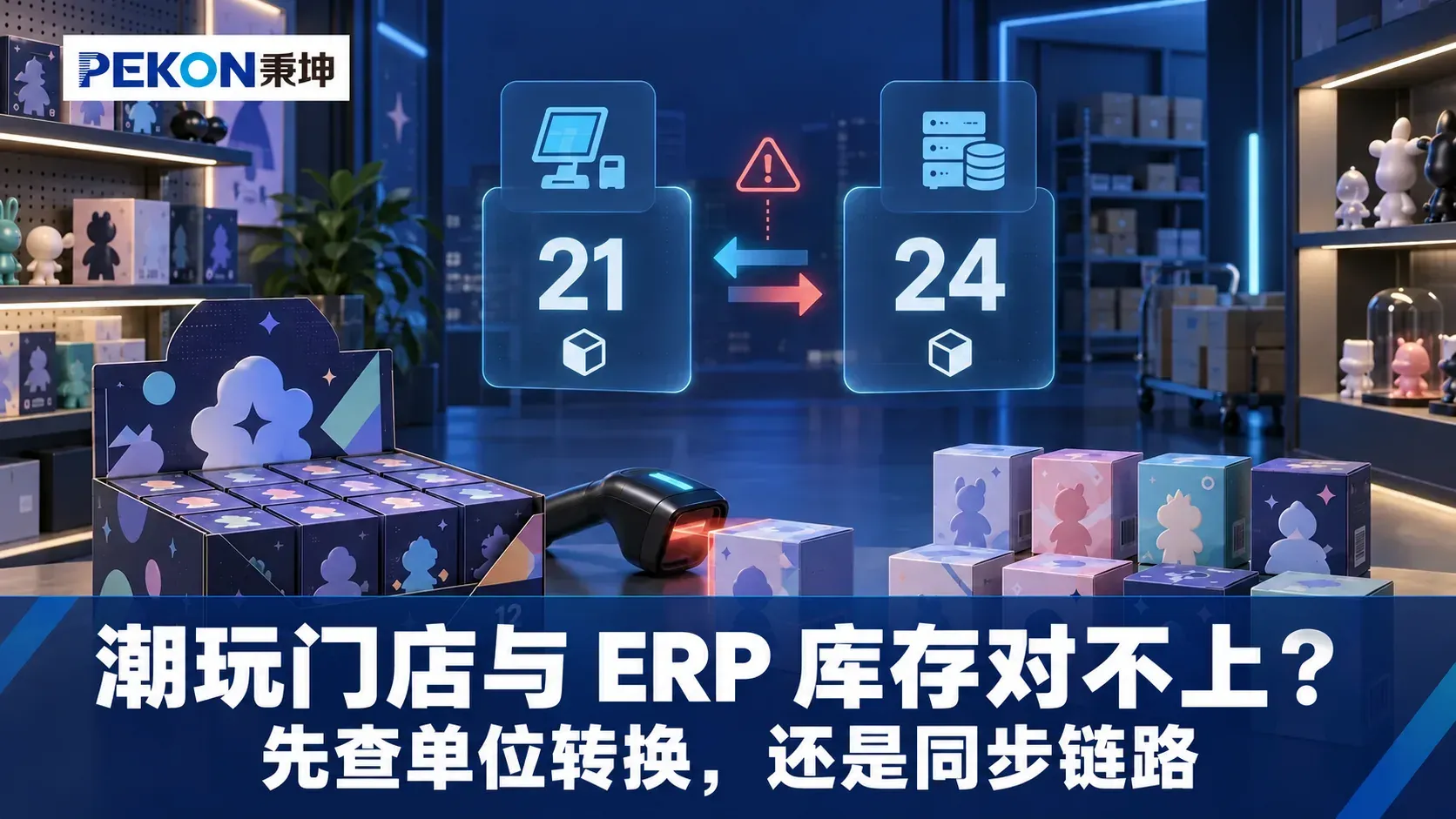
A store counts 21 individual boxes and its POS agrees, while ERP shows two PDQ packs containing 24 units. That difference alone does not establish a conversion error or a failed interface. First align the SKU, location, stock status and reporting cutoff. Then trace the first divergent receipt, unpacking, sale, return or transfer through the source documents and ERP posting records. This guide includes a worked example and an evidence worksheet for resolving the cause without hiding it behind a new balance.
Read more →
Returning one item can change an entire order’s eligibility for a gift, coupon or loyalty benefit. For complex promotional orders, reversing the full original transaction and creating a new sale for retained items can give store teams a clearer default process. This article explains the separate records needed for payments, loyalty and merchandise, the conditions for allowing partial returns, and the evidence to test at the POS. Product-quality issues and other required after-sales remedies need their own applicable process.
Read more →
A warehouse ships PDQ packs, a store sells individual boxes, and online shoppers collect orders from the same stock. Reliable integration starts by deciding which system records each action and which system receives the result. This article maps typical retail, ERP, WMS and OMS responsibilities, explains the handoffs for receiving, unpacking, stock reservations and returns, and sets out five questions to resolve before launch. The aim is a clear responsibility map, not a requirement to buy four separate software products.
Read more →
Beauty batch and expiry management depends on keeping physical products, inventory balances and documents aligned. This guide follows stock from store receipt through batch-based picking, expiry alerts and warehouse returns, with clear responsibilities and checks at each stage.
Read more →
Replacing a beauty retail system requires more than moving records between databases. This guide explains how brands can prepare product and SKU data, validate physical inventory, reconcile member identities and balances, and hand over unfinished transactions. It outlines the checks, responsibilities and exception handling needed to keep store operations and financial records aligned through migration.
Read more →
Selecting a luxury retail system for China requires more than a feature checklist. This guide helps headquarters and China teams assess mobile POS, VIP service, RFID, ERP and CRM integration, data security and project delivery, with seven questions to compare suppliers and plan a proof of concept.
Read more →
Completed sales can remain available for historical queries when a collectible-toy brand changes retail systems. Pre-orders, uncollected purchases and active returns still require fulfilment. Migrating them means preserving payments, stock reservations, loyalty benefits, limited-purchase eligibility and responsibility for the next action—not merely copying an order row. Before cutover, choose a complete route for each open-transaction category: finish in the old system or continue in the new one. Allowing both systems to modify the same order risks duplicate shipments and refunds, incorrect stock releases, duplicate coupon restoration and wrongly reinstated purchase eligibility.
Read more →
Assessing a retail-system supplier requires evidence beyond bulk imports. This guide explains how collectible toy brands can use representative records, conversion rules, discrepancy reports and business test scripts to evaluate data migration. It covers the deliverables and rehearsals needed for business teams to review results and support a controlled cutover.ua
Read more →
When a collectible-toy brand replaces its loyalty or retail system, customers notice whether they can sign in, whether their points are correct, and whether coupons and launch reservations still work. Migration must connect identities, preserve promised benefits and retain trustworthy data for future loyalty activity. Member counts and point totals alone are insufficient. Duplicate accounts, cross-channel identities, coupon states, tier validity, limited-event eligibility and tag origins can produce errors in individual accounts even when overall totals match.
Read more →
Inventory errors during a collectible-toy system replacement often begin with unclear units. Importing legacy codes and quantities for cartons, boxes, PDQ display packs and individual units unchanged can create duplicate stock, failed deductions after unpacking or inconsistent counting units on day one. Establish product identity and conversions first, then opening balances based on physical stock. The required outcome is a set of rules supporting box sales, individual sales, returns, transfers and counts—not simply a successfully imported product table.
Read more →
Thirty practical questions for retail system selection, organized around store transactions, inventory, membership and channels, and implementation. Based on PEKON’s customer discussions, the answers explain product capabilities, project customizations, and the boundaries between connected systems.
Read more →
Retail system requirements change as a brand grows from its first store to a multi-store network and group operations. Drawing on PEKON products and customer stories, this guide explains how brands can reuse product data, pricing and store configurations while managing differences between locations and operating models.
Read more →
Multi-brand beauty groups often operate multiple retail systems after years of acquisitions, creating duplicated interfaces, inconsistent reporting, and complex maintenance. This article explains how a unified retail architecture can support shared product capabilities while keeping each brand’s products, promotions, membership clubs, inventory, permissions, and regional rules independent. It also outlines transition options, cross-region considerations, and three practical tests for evaluating whether an architecture can support continued brand expansion.
Read more →
Opening a beauty care franchise network requires clear service standards, store responsibilities and supply processes. This article explains how headquarters can support franchisees with membership, service packages, inventory ordering and operating data, while defining which rules and activities each system owns.
Read more →
Retail groups need a shared system that can accommodate changes in brands, legal entities, regions and store formats. This article explains how a unified retail foundation can support distinct product, pricing, promotion, loyalty, inventory and reporting requirements as the group develops.
Read more →