
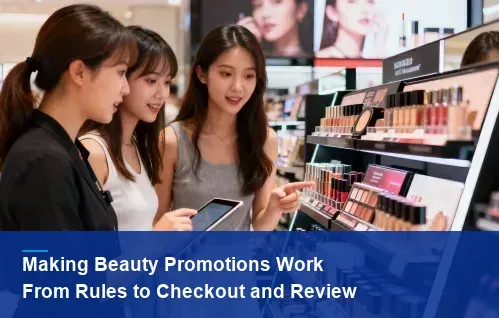
Making Beauty Promotions Work: From Rule Configuration to Checkout and Review
Spend-and-receive gifts, half-price second items, product bundles, member discounts and category-specific rewards make beauty promotions more demanding than a simple price reduction. When store teams interpret these offers manually, checkout errors, gift discrepancies and difficult financial reconciliation can follow.
A promotion management system needs to connect the offer as designed by marketing with what happens at checkout, in inventory and during the campaign review.
1. Turn campaign policies into executable rules
Start by separating the conditions of an offer from its actions. Conditions can include eligible products, stores, members, dates, basket value, categories and channels. Actions can include discounts, gifts, bonus points, vouchers or bundle pricing.
The system also needs clear priorities and rules for combining offers. Which discount applies first? Which offers are mutually exclusive? Which may be combined, and what exceptions apply? Configuring these relationships helps prevent stores from interpreting the same campaign differently.
2. Apply the rules consistently at checkout
At the POS, the system should match the member, products, time, purchase value and store against the configured conditions. It should display the relevant discount and gift breakdown, apply the appropriate deductions and identify the gifts to issue.
This reduces dependence on staff calculating a complicated basket from memory. It also gives the advisor a clearer explanation of the customer's final price and benefits.
3. Connect gift issue to inventory
A promotional gift is still a physical item. Each issue needs a record linked to the relevant transaction, with stock deducted through the defined workflow.
Campaign, store, product and member limits should be reflected in execution. When a gift is scarce, inventory visibility helps the business monitor availability rather than discovering a shortage only when a customer qualifies at checkout.
4. Make campaign results traceable
For each order, retain the promotion rules applied, discount amount, gifts issued, member and store. These transaction-level records provide a common basis for marketing and finance to review campaign sales, total discounts, gift costs, new-member participation and repeat-customer participation.
Reporting is more useful when campaign totals can be traced back to individual transactions. The business can then investigate discrepancies and evaluate how the offer performed without reconstructing the campaign from separate store spreadsheets.
5. Connect promotions with the wider retail system
PEKON Smart Retail System connects POS, CRM and inventory with promotion rules. The purpose is to carry a campaign through configuration, checkout, stock movements and reporting, giving store staff and head-office teams a consistent operational record.
Frequently asked questions
What types of beauty promotions need rule-based management?
Examples include threshold gifts, discounted second items, bundles, member pricing, category-specific gifts, points and vouchers. The complexity lies both in each offer and in how several offers interact.
How can a brand control unintended discount combinations?
Define priorities, permitted combinations, exclusions and exceptions. Check those relationships against representative baskets before the campaign is used in stores.
Why connect the promotion engine to POS?
The configured policy must be executable at checkout. Matching eligibility and showing the calculation reduces inconsistent manual interpretation.
Why include gifts in inventory management?
Gifts create stock movements and campaign costs even when customers do not pay for them separately. Linking each issue to a transaction supports stock control and reconciliation.