Classifying Products and Stores as A/B/C: How Can Replenishment Standards Reflect Operational Differences?
When planning replenishment, brands need to place inventory where there is a stronger opportunity for sales. Bestselling products should have a lower risk of stockouts, while slow-moving products require tighter inventory control. Stores with different business volumes also need different inventory arrangements.
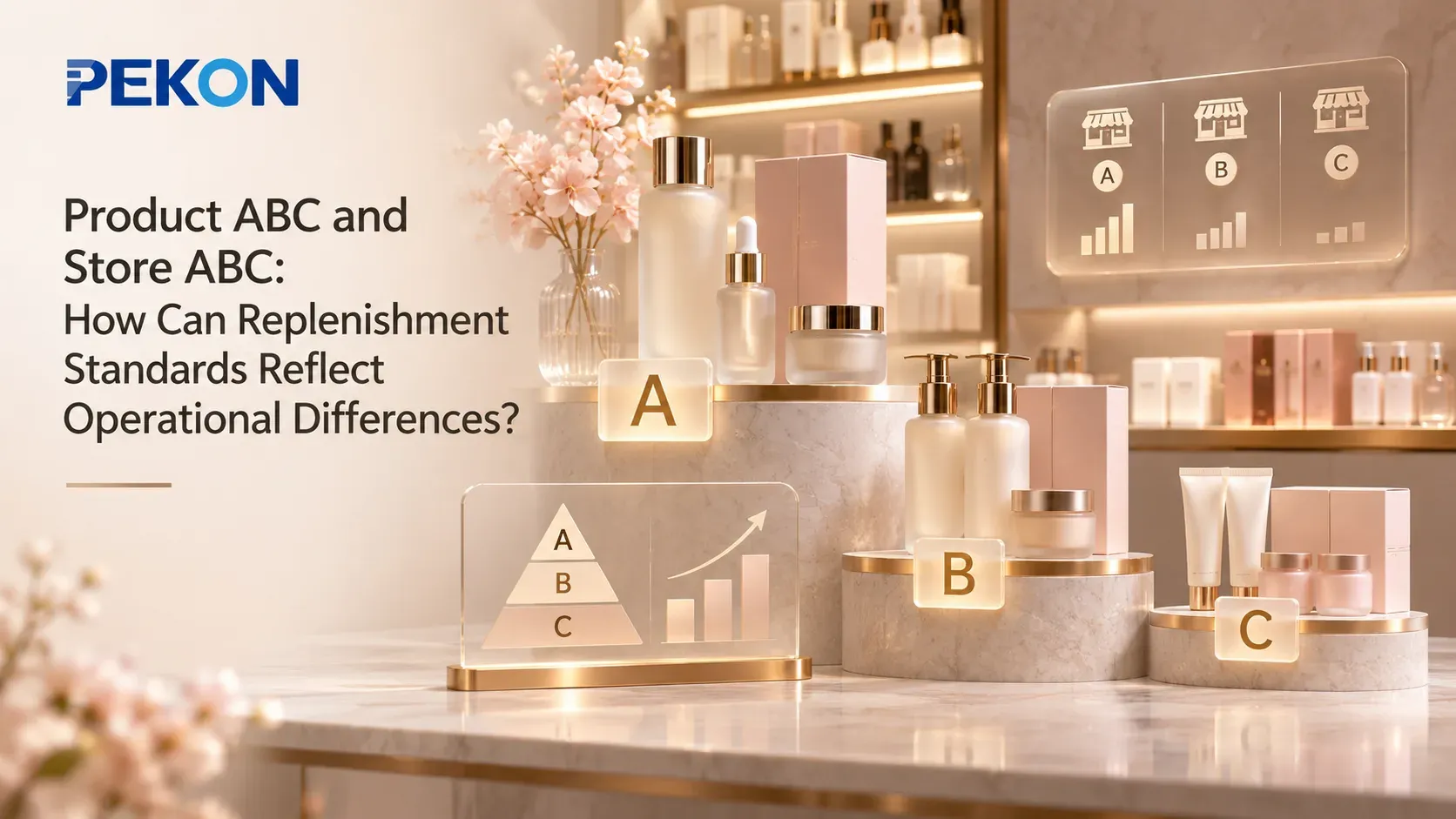
Classifying products into A/B/C categories, classifying stores into A/B/C categories, and then combining the two classifications to design replenishment strategies is a practical and reasonable management approach. It allows product teams to focus on key priorities before setting specific quantities, instead of creating replenishment rules from scratch for every store and every product.
The role of ordering and inventory optimization software is to apply this classification method to daily calculations: different stores and products can follow different replenishment rules, generate quantity suggestions, and then be adjusted by the product team according to actual business conditions.
Classify Products as A/B/C to Identify Items That Need Priority Protection
Using sales contribution as an example, A-class products are usually important sources of brand sales. Stockouts may directly affect business performance, so supply needs to be monitored closely. B-class products should maintain normal turnover, while C-class products require more cautious inventory planning to reduce the accumulation of items that remain unsold for long periods.
After classification, the product team has a clearer replenishment focus. The availability of priority products can be monitored more closely, while inventory investment in low-contribution products can be controlled. Brands may also classify products according to gross margin contribution or other business objectives. The key is to ensure that the classification criteria are aligned with the operating goal.
Classification does not directly determine how much to replenish. An A-class product may have high sales volume but require only a limited inventory level if replenishment is timely. A C-class product may sell slowly but still require a minimum quantity for necessary display. ABC classification first defines the management priority, while the specific quantity must be calculated separately.
Classify Stores as A/B/C to Define Their Inventory Support Requirements
The sales opportunity for the same product can vary from one store to another. A store with a larger sales volume and a store with a smaller sales volume typically do not need to prepare the same quantity of inventory.
Product classification answers the question, “Which products are important?” Store classification further answers, “Which stores should receive these products, and what level of support do they require?” Only by combining the two can replenishment account for both product importance and actual store demand.
For example, a bestselling essence may sell steadily every day in a priority store and therefore needs to remain available. In another store, the same product may mainly serve occasional customer demand, so inventory can be planned more cautiously. It remains an A-class product for the brand, but different stores may use different replenishment arrangements.
Combine Product ABC and Store ABC to Establish Shared Replenishment Rules
The following table uses product sales contribution and store sales scale as examples to illustrate different replenishment approaches.
| Combination | Replenishment Focus |
|---|---|
| A-class product × A-class store | Pay close attention to stockout risk and ensure that key-selling products are replenished promptly. |
| A-class product × B- or C-class store | Preserve the sales opportunity for bestselling products while setting quantities according to the store’s actual demand. |
| B-class product × Any store class | Maintain normal turnover according to the store’s sales performance. |
| C-class product × A-class store | Distinguish between necessary category display and actual sales demand, and control excess inventory. |
| C-class product × B- or C-class store | Replenish cautiously, reduce inefficient inventory occupation, and retain products that genuinely sell well in the specific store. |
The advantage of this approach is that similar situations can follow similar operating principles. Product managers can use classifications to manage most products and stores, while spending more time on major changes and a small number of special cases.
Classification does not replace the sales performance of individual stores. A C-class store may have one product that sells particularly well, while an A-class store may have a product that remains slow-moving for a long time. These situations can be adjusted separately without changing the classification of the entire store because of one product.
Use Software to Convert Classification into Replenishment Quantities
When a brand manages hundreds of stores and thousands of SKUs, a classification table alone is not enough. Every ordering cycle requires the classification strategy, sales data and inventory data to be calculated together. PEKON’s ordering and inventory optimization solution supports the conversion of these business decisions into replenishment rules and quantity suggestions.
First, map classifications to replenishment rules. Product tags and tags assigned to store-product combinations can record classifications across different scopes. Differentiated parameters and ordering rules can express different replenishment requirements. How store tiers and product categories participate in matching should be configured according to the brand’s operating rules during implementation.
Then calculate the suggested quantity for each store and product. Even when two stores carry the same A-class product, they do not necessarily receive the same quantity. The calculation can consider each store’s sales volume, current inventory and, depending on the formula, inventory in transit and other relevant data. Classification determines which strategy applies, while business data determines how much should be replenished this time.
Run a simulation before adjusting the strategy. Product teams can use suggested quantities to simulate the result of a rule adjustment, review which stores would receive more or less inventory, and then decide whether to apply the change. When a small number of stores or products require special treatment, specific parameter values can also be set for designated stores or products. The exact formulas, data sources and rule scope should be confirmed during the project.
In this way, the product team manages a replenishment rule set that can be executed continuously. The system handles daily calculations, while people focus on whether the suggestions reflect actual business conditions and which classifications or parameters need adjustment.
Coordinate Classification with Ordering Algorithms to Focus Inventory Investment
Product ABC and store ABC provide a clear operating direction for replenishment. Ordering algorithms convert that direction into executable quantity suggestions. Only by combining the two can brands continuously apply differentiated inventory management across a large number of stores and products.
Through classification tags, differentiated parameters, ordering rules and quantity simulations, PEKON supports brands in applying existing product management experience to daily replenishment. Product managers can retain their judgment over key products, priority stores and special requirements, while reducing repetitive calculations and item-by-item maintenance.
For more information about the roles of different inventory tools, read “How to Choose an Inventory Management System: ERP Replenishment, BI Dashboards or an AI Inventory Optimization Engine?”
To discuss how existing product classifications, store tiers and ordering rules can be applied to daily replenishment, contact PEKON for a solution consultation.