
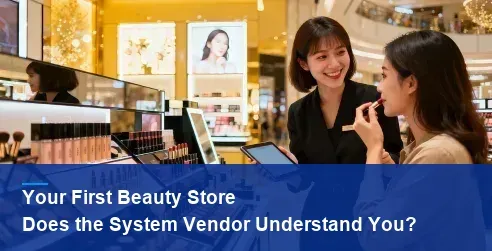
Choosing a Retail System for Your First Beauty Store: Does the Vendor Understand Your Business?
Opening a first store, taking an online brand into physical retail or replacing an existing platform all raise the same question: does the software provider understand how a beauty business operates? A feature checklist is a starting point. Industry experience, realistic operating scenarios and the ability to support future growth are more useful tests.
1. Look beyond a list of functions
A POS, a membership module and inventory reports do not necessarily form a workable beauty retail system. Beauty advisors need customer preferences and service histories. Samples need their own issue records. Benefits may need to work across online and offline channels, while stores may fulfil online orders or provide associated services.
The first store establishes the foundations for customer identity, benefits, service records and repeat-purchase reminders. Assess how those foundations connect, rather than treating the initial installation as an isolated project.
2. Ask what comparable customer projects actually involved
Relevant scenarios matter more than recognizable names
Ask vendors to explain work such as cross-counter sales attribution, sample distribution, points redemption and store collection. For an online-first brand, a comparable project might connect Tmall, a WeChat mini-program, store POS and CRM. For an international brand entering China, the relevant question is how local store operations fit into the wider organization.
Follow the entire operating chain
Review customer-facing POS, mini-program and WeCom service; the underlying points, benefits, inventory, promotions and orders; and reporting on basket size, attachment sales, repeat purchases and advisor productivity. Records should remain traceable as the business grows.
Check the industry-specific data model
Beauty operations need batches, shelf life, testers, gifts and sets. Luxury watches and jewellery may require unique item identifiers, certificates and after-sales records. Care chains need appointments and ongoing service histories. Ask whether these requirements are part of the product design or additions that would need to be built after implementation.
3. Run a demonstration around real store work
A customer journey with several benefits
Use a scenario in which a gold-tier member has placed an online order and holds a soon-to-expire new-product voucher. At collection, the customer requests gift wrapping, buys a serum, earns points, claims a birthday gift and redeems a complimentary skin assessment. The demonstration should connect identity, vouchers, rewards, stock, services, advisor attribution and fulfilment.
Samples and testers
Test separate receipt, campaign allocation, customer requests and issue records. Stock should be deducted through the appropriate workflow, with a connection between sampling and subsequent full-size purchases where the customer can be identified.
Appointments and follow-up
Have the vendor demonstrate an online appointment, the in-store treatment record and subsequent follow-up using relevant customer preferences. A beauty customer relationship often extends beyond the purchase itself.
4. Assess the system's capacity to grow
Useful industry data
Look for fields and workflows that capture skin type, preferences, product categories, purchase cycles, care services, advisor relationships, campaigns, samples and benefits. Then check whether that information supports cross-selling, repeat-purchase analysis, advisor performance and event review.
Open integration
Ask how the system connects Tmall, mini-programs, WeCom and other channels for private-domain customer engagement. A credible design should explain how identity, benefits, orders, inventory and fulfilment remain consistent across those connections.
Evidence of product development
Review the previous year's releases. Have beauty, luxury, care, collectible toy or health-sector requirements led to practical improvements? Examples might include inventory for mini-program livestream sales, WeCom store associate engagement benefits or service workflows. Specific releases reveal more about long-term responsiveness than a general promise to customize.
5. Match the assessment to your starting point
- Online-first brands: preserve existing customer relationships when introducing stores, including identity, order history, service, advisor support and benefits.
- Brands operating across ecommerce platforms: examine the connections among platform membership, POS, CRM, mini-programs and WeCom.
- Brands replacing an existing system: assess migration of members, products, stock and orders, alongside staff training and continuity of store operations.
6. Recognize industry expertise in the details
Industry knowledge appears in data fields, workflows, permissions and reports. A capable supplier identifies difficult scenarios early, explains the boundaries of the proposed solution and shows how the design supports later stages of growth.
PEKON has worked in retail digitalization since 2009, serving more than 200 brands, including beauty and luxury businesses. When assessing any supplier, use that experience as a starting point for detailed scenario testing.
Frequently asked questions
Why plan loyalty before opening the first store?
The first store begins accumulating customer identities, benefits and service histories. Planning those connections early helps preserve the value of that information as more stores and channels are added.
Which capabilities deserve priority?
Evaluate membership, POS, promotions, inventory, samples and service workflows together, including their connections to the brand's existing channels.
How can a brand verify a vendor's industry experience?
Ask for comparable project scenarios and demonstrate your own operating cases. Check the underlying records and reports, not just the screen presentation.
What should an online-first beauty brand plan?
Plan how online customer identities, benefits and orders will connect to store service, advisor activity and fulfilment.
How should future omnichannel needs affect the decision?
Review integration boundaries and the consistency of customer, order, stock and benefit data before committing to the first-store setup.
Related product: PEKON Smart Retail System.