
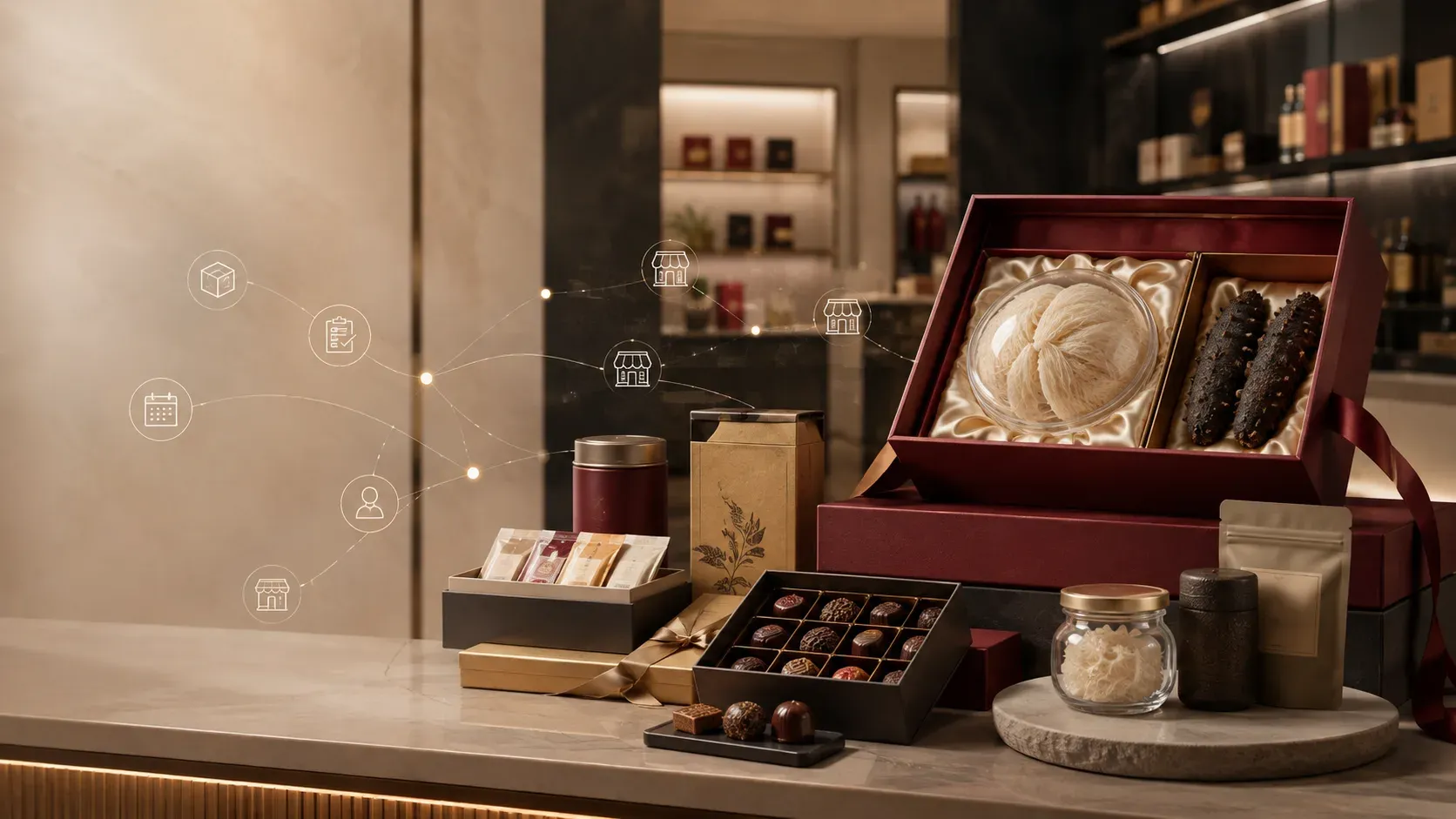
Premium bird’s nest, sea cucumber, chocolate and tea brands may experience concentrated gift-box demand around Chinese New Year and Mid-Autumn Festival while also serving everyday consumption and repeat purchases. The same stores and products must support two different operating rhythms.
As stores expand, a regular item may also become a gift-box component, and a customer may purchase both for personal use and seasonal gifting. Product roles change, but inventory, member and store records must stay consistent. Selection should test common records with separately configurable rules.
Gifting and repeat purchase are roles, not fixed categories
A product used for everyday consumption may become a seasonal gift component. Its priorities shift from purchase history, available stock and expiry to assembly, concentrated stocking, store allocation and post-season leftovers. It can serve both roles at once.
| Dimension | Gifting | Repeat purchase |
|---|---|---|
| Demand | Concentrated around seasonal or occasion windows | Continuing transactions and varied customer intervals |
| Products | Gift sets, bundles and limited packaging | Regular items, categories and purchase records |
| Inventory | Pre-season preparation, requests, peaks and leftovers | Turnover, replenishment, batches and expiry |
| Loyalty | Gift occasions, seasonal purchases and group buying | History, category preferences and ongoing contact |
| Headquarters view | Readiness and execution within a sales window | Longer-term purchasing and stock changes |
A generic “food industry” label is insufficient. Verify consistent product, stock, batch, store, customer and transaction records alongside different operating rules.
Turn seasonal peaks into executable workflows
Once gift structures are agreed, headquarters needs component availability, store requirements, request approval and fulfilment. During the peak it must see gift and component balances; afterwards it must decide how remaining goods can be transferred or sold.
How does a gift sale change component stock?
Without a defined relationship, the system may show components still available after they have been sold inside gifts, or show no gift stock despite available components. Choose the model that matches physical packing and sales.
| Method | Inventory treatment | Scenario |
|---|---|---|
| Physical kit | Finished gift set holds its own stock | Prepacked, fixed finished goods |
| Virtual bundle | Sale deducts configured components | Store assembly or flexible packing |
| Promotional combination | Items retain separate stock; qualifying combinations receive offers | Buy-A-get-B, mix-and-match or bundle discounts |
| Conversion or reverse BOM | Approved conversion from sets or large packs into smaller units | Unpacking and post-season treatment |
Use an actual gift structure to demonstrate setup, sale, disassembly and adjustments. PEKON’s branded-food solution describes POS BOM assembly and virtual-component deductions; product materials also describe physical kits, promotional combinations and conversions. Select the appropriate method rather than the largest feature count.
Can seasonal promotion rules reach the store?
Offers can include spend thresholds, gifts, add-on purchases, buy-one-get-one, second-item discounts or buy-A-get-B. Configure eligible products and stores, start and end times, front-end recognition, price-change permissions and audit records. Test execution, not an assumed sales outcome.
How do store requests enter headquarters processing?
Stores differ in catchment, sales and stock. Test a pre-season request through headquarters review, inventory confirmation, approval, ERP handover, dispatch and receipt. Company-owned, franchise and regional stores may need different product scopes, prices and approvals.
A configured request-and-approval workflow is distinct from calculated order recommendations. Recommended quantities or intelligent replenishment depend on data, algorithms, parameters and project scope. Ask suppliers to explain those separately.
What happens to stock after the peak?
Remaining goods retain location, batch and expiry. Identify stock distribution, time to expiry and demand elsewhere before deciding on transfers or other treatment. Retail can provide queries, alerts and transfers. Inventory optimisation may add recommendations after data preparation and business calibration, with decisions still reviewed by the operating team. Do not assume unvalidated accuracy in seasonal forecasting.
Check repeat-purchase activity against availability and expiry
Repeat purchasing is not just a CRM-contact question. Household, seasonal and usage differences mean customers do not all buy on fixed cycles. A campaign also needs suitable goods in the stores that will serve those customers.
Start with usable purchase facts
Within authorised data and project scope, connect member identity with purchases by time, store and item. PEKON Omnichannel CRM & Loyalty Platform supports identity, tags, points, benefits and contact. Test how recorded campaign source, products, dates and tags support brand-defined seasonal or everyday audiences. The system does not automatically know whether a purchase was a gift or for personal use.
Purchase intervals provide reference, not a universal consumption schedule. Start with categories whose paths are reasonably clear, configure initial rules from available records and refine them through observed results.
Keep campaigns connected to saleable stock
Contact based only on purchase history can create interest when nearby stores lack stock or products approach the brand’s expiry threshold. Define how the team checks availability and product status before committing to a campaign.
CRM owns identity, rules and contact; retail and inventory systems own store availability, batches and expiry. Their agreed responsibilities and project connections should support operating decisions without assuming CRM replaces stock management.
Preserve batches within the same SKU
A SKU may contain several batches with different remaining shelf lives across stores. Test receipt, sale, count and transfer records, configurable near-expiry thresholds and headquarters visibility. Define boundaries with ERP and warehouse systems: store batch records do not imply a complete WMS replacement.
Share core records while varying the rules
| Object | Shared records | Gifting rules | Repeat-purchase rules |
|---|---|---|---|
| Products | SKU, combinations, prices and store scope | Gift sets, limited combinations and windows | Regular items and categories |
| Inventory | Store, batch, expiry and status | Preparation, concentrated requests and leftovers | Daily replenishment, turnover and expiry |
| Members | Identity and purchases | Seasonal rules based on recorded evidence | History and continuing engagement |
| Stores | Organisation, permissions and transactions | Peak sales and temporary requests | Daily retail and member service |
| Headquarters | Consistent facts and metrics | Readiness, sales and remaining stock | Long-term buying, inventory and fulfilment |
Shared records prevent conflicting gift and regular-item balances or duplicate member profiles. Distinct rules avoid applying seasonal stocking to every everyday item or interpreting a short peak as normal repeat demand.
The PEKON Smart Retail System covers POS, products, stock, orders and operating data; CRM covers identities, entitlements and engagement. Store requests feed headquarters processes. The PEKON AI Inventory Optimization Engine can support replenishment, transfer and return recommendations after data preparation, configuration and calibration. Confirm scope against existing ERP, warehouse, e-commerce and project arrangements.
Demonstrate the complete operating cycle
Prepare a multi-component gift set, two batches of one SKU, three stores with different stock and sales, and a member with both seasonal and everyday purchases.
- Choose physical, virtual, promotional or conversion treatment and show stock changes after sale or disassembly.
- Use one component as both a regular item and part of a gift, preserving consistent records.
- Configure promotion scope, timing, execution and price permissions.
- Follow a store request through approval, ERP handover, dispatch and receipt, separating recommendation functionality.
- Test batch and expiry continuity across receipt, query, sale, count and transfer rather than assuming it.
- Configure near-expiry thresholds and inspect store and headquarters visibility.
- Query member purchase facts and explain audience rules.
- Show how campaign teams check stock, location and expiry without assuming automatic CRM-stock linkage.
- Handle post-season goods through queries, alerts and transfers, distinguishing optional optimisation recommendations and human approval.
- Identify responsibilities retained by retail, ERP, finance, warehouse and e-commerce systems.
Judge whether information is recorded, role changes preserve consistency, rules are configurable, exceptions are visible and results feed subsequent steps.
Frequently asked questions
How does branded-food retail software differ from basic POS?
Beyond checkout, the required scope may include gift components, batches and expiry, store requests, purchase history and multi-store feedback. Validate whole workflows.
Can gift sets and individual products share inventory management?
Yes, with the appropriate physical, virtual, promotional or conversion model. Test sale and disassembly effects, including batch and expiry preservation.
What are forward and reverse BOM scenarios?
Forward BOM has two stock treatments: physical sets hold independent stock; virtual sets deduct components. Promotional combinations are pricing rules, not BOM stock management. Reverse conversion breaks larger packs into smaller units—for example, reducing a box of masks and increasing individual masks before selling them.
What should expiry tests cover?
Separate batches within a SKU, continuity through movements, configurable thresholds, cross-store visibility and clear ERP/WMS boundaries.
What matters for bird’s nest, sea cucumber and other premium nutritional foods?
Gift-component relationships, requests and approval, batches, expiry, availability and customer history across seasonal and everyday sales, with clear enterprise-system responsibilities.
Do gifting and repeat sales require separate systems?
Usually not solely because demand rhythms differ. They need consistent records with separately configurable operating rules.
Plan around the two demand rhythms
Map representative goods as regular items and seasonal components. Identify store requests, expiry pressure and customer activity that depends on local stock, then assign records and actions to systems. Evaluate PEKON’s branded-food solution against the brand’s current architecture, store model and operating stage.