
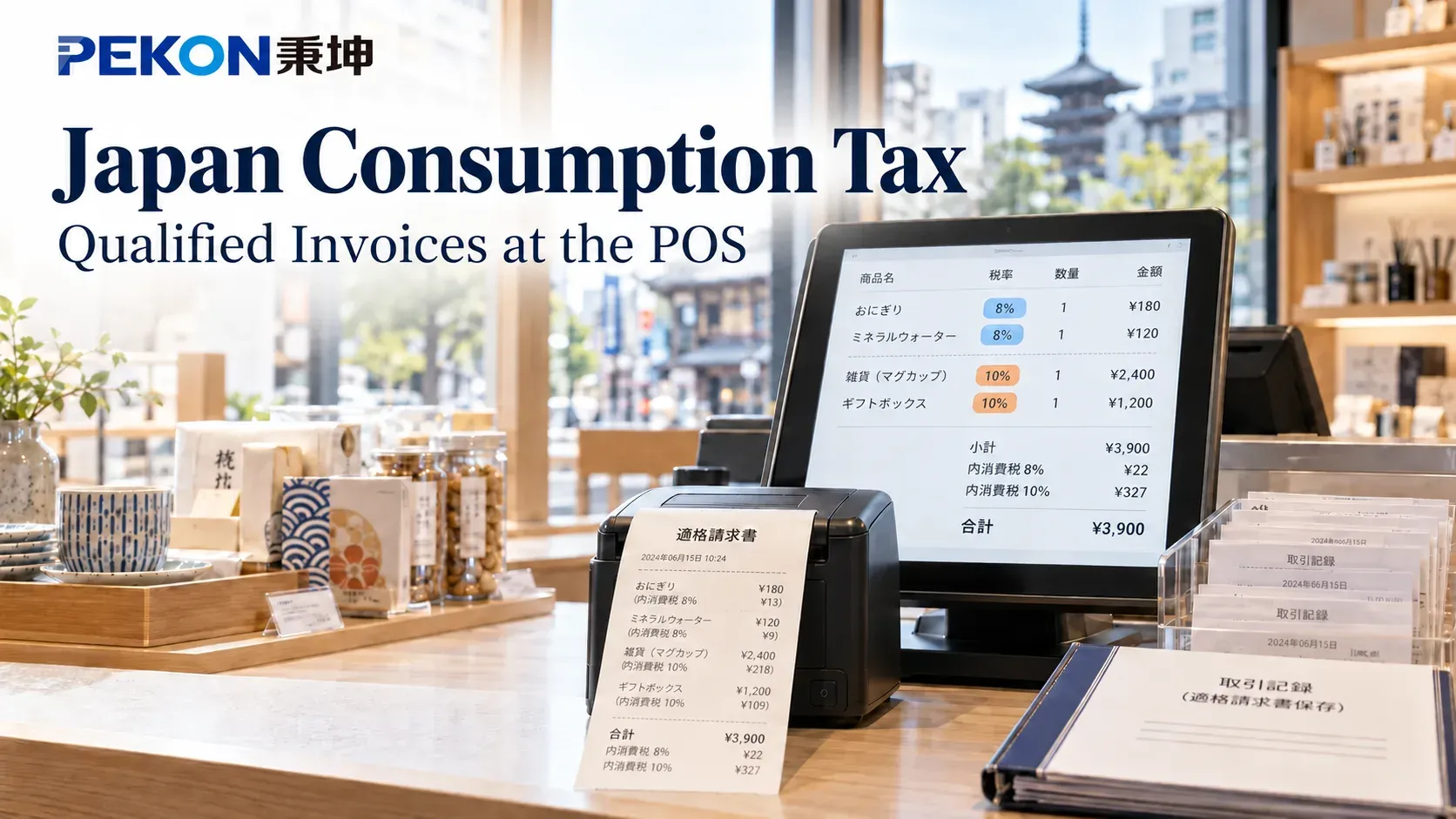
A brand opening stores in Japan may already have a global POS and a standard receipt template. The local implementation still needs decisions about the registered invoice issuer, consumption tax calculation and the documents issued when a transaction changes.
Japan’s qualified invoice system is different from a workflow in which every retail transaction must receive an immediate validation identifier from the tax authority. Retailers should design around the Japanese document requirements rather than copy an e-invoicing process from another market.
When a retail receipt can be a qualified invoice
The qualified invoice system began on 1 October 2023. It supports the documentation required for consumption tax input tax credits. A registered issuer in an eligible business, including retail, may issue a qualified simplified invoice. A receipt can fulfil this role when its contents meet the applicable requirements; the document’s heading alone does not make it compliant.
The simplified document generally identifies the issuer and its registration number, transaction date, transaction details including the indication of reduced-rate items, and the total consideration grouped by tax rate. It must also provide the applicable tax rate or the consumption tax amount for each rate. Unlike a full qualified invoice, it may omit the recipient’s name.
Local finance should approve the exact template and retention process. A store receipt number identifies a transaction; it does not replace the issuer’s registration number.
Map the issuer to the store and the effective period
A qualified invoice issuer’s registration number begins with T followed by 13 digits. For a corporation with a corporate number, the registration number follows the prescribed relationship to that number; other issuers receive an assigned number. The important implementation step is to map the correct registered issuer to each issuing location and effective period.
Do not assume the brand name, payment merchant and legal issuer are always the same entity. Franchise stores, concessions and multiple operating companies may require different mappings. Receipt information, payment settlement and accounting records need an agreed relationship even where their identifiers differ.
A historical reprint should retain the issuer information applicable to the original transaction. Changing a store’s current registration settings must not silently replace the issuer on older sales.
Calculate tax from item-level treatment
The baseline rules discussed in the Chinese article use a 10% standard rate and an 8% reduced rate for eligible supplies. Eligible food and drink excluding alcohol generally fall within the reduced-rate framework, while restaurant dining, alcohol and non-food goods generally follow the standard rate. Local finance should confirm product classification, bundled-sale treatment and any applicable exceptions.
Where eligible food is sold for takeaway or dine-in consumption, the transaction context matters. A POS should capture the agreed distinction rather than apply a single food-category rate indiscriminately. A mixed basket may contain both rates.
The calculation sequence also matters. Allocate discounts using the approved method, determine the taxable amounts by rate, and then calculate the tax amounts. The POS, receipt and accounting interface must use consistent amounts and rounding conventions.
The National Tax Agency’s guidance requires fractional tax rounding once for each tax rate on a single invoice. Rounding each item’s tax and adding those rounded amounts can produce a different result. The business should choose an allowed rounding method and apply it consistently to the invoice calculation.
Keep future tax changes separate from live rules
Official materials available in October 2026 describe a proposed temporary reduction beginning on 1 April 2027. A proposal or explanatory page should not be treated as an enacted operating rule. Confirm the enacted legislation, covered goods, effective period and final guidance before rollout.
The system should nevertheless support effective-dated tax settings. Future configuration needs to coexist with historical transaction data so that a return or reprint after a rate change uses the correct original basis. The project should include a controlled activation and verification process rather than a manual replacement of every product’s historical rate.
Returns, corrections and retention must preserve the original basis
A full or partial return should refer to the original sale, issuer, rate, taxable amount and tax calculation. The refund payment and the required tax document are related records with separate responsibilities. Where a qualified return invoice is required, the workflow must produce the relevant information under the applicable rules.
For an error in an issued document, the correction may involve a complete corrected document or supplementary information clearly linked to the original. Finance should approve the chosen approach and the circumstances in which each document is issued.
Copies or electronic records of issued qualified invoices must be retained for the statutory period. The general seven-year retention period is measured under the prescribed tax-period rules, not simply seven years from the cashier’s printing date. Confirm the start point, storage method and applicable electronic record requirements with local finance.
The store should be able to retrieve the original and corrected records together. A reprint must not look like a new sale or introduce current tax settings into an old transaction.
Translate approved finance rules into an acceptance plan
PEKON Smart Retail provides retail transaction, product, promotion, order and receipt capabilities. Tax rates and receipt templates form part of the configuration discussion, while headquarters reporting and ERP connections depend on the agreed interfaces. Dine-in versus takeaway treatment, multiple issuers and other specific requirements should be confirmed in the project scope rather than presumed to be standard in every deployment.
A workable sequence is: local finance approves the tax and document rules; the team maps parameters, fields and receipt templates; the implementation team runs agreed scenarios; finance and operations verify the evidence. The software supplier should identify which requirements are standard, configurable, integration work or additional development.
- Ordinary sale: correct issuer, registration number, tax rate and receipt totals.
- Mixed-rate basket: separate tax bases and required rate information.
- Discount: approved allocation and rounding at the correct level.
- Partial return: original tax basis, return document and payment linkage.
- Historical reprint: original issuer and rates after configuration changes.
- ERP reconciliation: matching transaction, tax and adjustment amounts, with clear treatment of timing differences.
Do not use a China-style fapiao or Malaysia-style MyInvois validation demonstration as evidence that these Japanese scenarios are covered. The acceptance documents should reflect the local process.
Frequently asked questions
Can a normal-looking retail receipt serve as a qualified invoice?
Yes, an eligible registered issuer’s receipt can serve as a qualified simplified invoice when it contains the required information. The format’s title alone is not sufficient.
Should takeaway and dine-in food always use the same rate?
No. Eligible takeaway food and dine-in service can have different tax treatment. Confirm the goods and transaction conditions with local finance.
Does each retail sale need real-time upload and validation by the tax authority?
That is not the standard requirement of Japan’s qualified invoice system. Focus on issuer registration, accurate documents, calculation, retention and the applicable reporting obligations.
Official references
Use the National Tax Agency’s qualified invoice resources and consumption tax rate guidance. For the proposed change, consult the NTA explanatory page and confirm its legislative status before using it in production settings.