
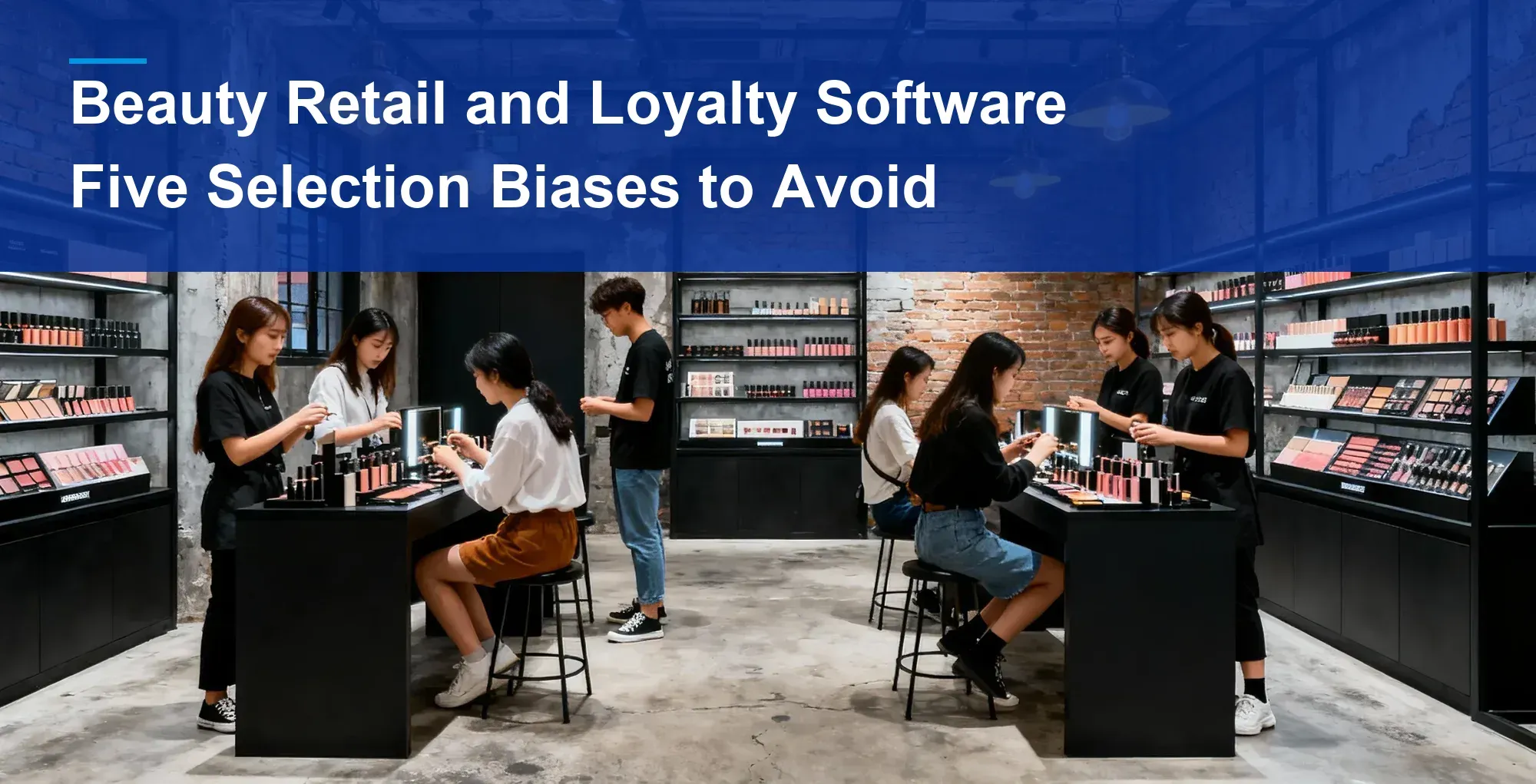
Five Selection Biases to Avoid When Choosing Beauty Retail and Loyalty Software
Retail and loyalty software affects store execution, customer records, advisor service, inventory and future channel growth. Choosing it requires more than a feature comparison and initial quote.
Five common assumptions can distract a beauty brand from the actual workflows it needs to support.
1. More features must mean a better fit
A long list of checkout, loyalty, stock, promotions and reports does not establish depth. Beauty-specific questions include separate tester records, advisor attribution across counters, relevant customer preferences, digital benefits used in store, gifts and treatments.
Test recognition, redemption, promotion calculation, gift stock, service records and follow-up in one realistic journey. The connections matter more than the number of menu items.
2. A perpetual licence must be cheaper than SaaS
An upfront licence can be followed by server, operations, upgrade, integration, customisation and support costs. A subscription typically includes a continuing service model, but its scope still needs to be checked.
Compare three-to-five-year total ownership cost, including implementation, training, maintenance, interfaces, changes and eventual replacement. Match the model to growth plans and the brand's ability to operate the system.
3. The shortest implementation must be best
An unrealistic schedule can compress process mapping, testing, migration, opening stock, permissions and staff training. The result may be a fast launch followed by operating problems.
A first store establishes practices that will later be copied. Validate core journeys such as coupon redemption, trial records, samples, points gifts and collection of online orders before rollout.
4. The lowest quote should lead the decision
A lower starting price may omit work or support that becomes essential later. Disruption to checkout, benefits or inventory can outweigh procurement savings.
Review industry experience, product maturity, implementation, service response, expansion capacity and data security together. Relevant beauty experience helps identify complexity before it becomes a costly project surprise.
5. Selection belongs only to IT
IT should assess architecture, interfaces, stability, security and migration. Store, merchandise, loyalty, service and finance teams must also test their work.
Can advisors retrieve useful history? Can operations configure campaigns? Can merchandise teams track gifts and testers? Can finance trace promotion costs? A technically connected system may still be difficult to operate.
Test whether the supplier understands beauty retail
Use a scenario involving a member buying a full-size product, applying a discount and points, receiving a birthday gift or sample, recording a service preference and generating a later follow-up.
This reveals whether membership, transaction rules, non-sale stock and advisor tasks form a coherent process. It also distinguishes existing functionality from work that needs configuration, integration or development.
Use a broader decision framework
Assess business fit, total cost, delivery quality, industry understanding, cross-functional usability and future change together. For a first-store brand, the system becomes a foundation for later replication and customer development.
PEKON’s beauty retail materials and PEKON Smart Retail System materials can provide context for POS, CRM, inventory, promotions and connected operations, but the brand's own scenarios should determine fit.
Frequently asked questions
Why might a generic membership tool be insufficient?
Beauty operations add service records, samples, gifts, advisor follow-up and connected store execution to basic points and coupons.
Which capabilities deserve priority?
Identity, benefits, redemption, non-sale stock, advisor tasks, profiles, repeat-purchase analysis and POS/channel coordination.
Which commercial model is preferable?
It depends on scale, change, internal resources and total cost. SaaS can support continuing updates, while the actual service scope must be confirmed.
How can industry knowledge be verified?
Require a demonstration using a realistic combination of member benefits, promotions, samples, gifts and service follow-up.
What matters when replacing an older system?
Member and benefit migration, products, stock, orders, training and launch support all require planning. It is an operating transition as well as a technical one.