
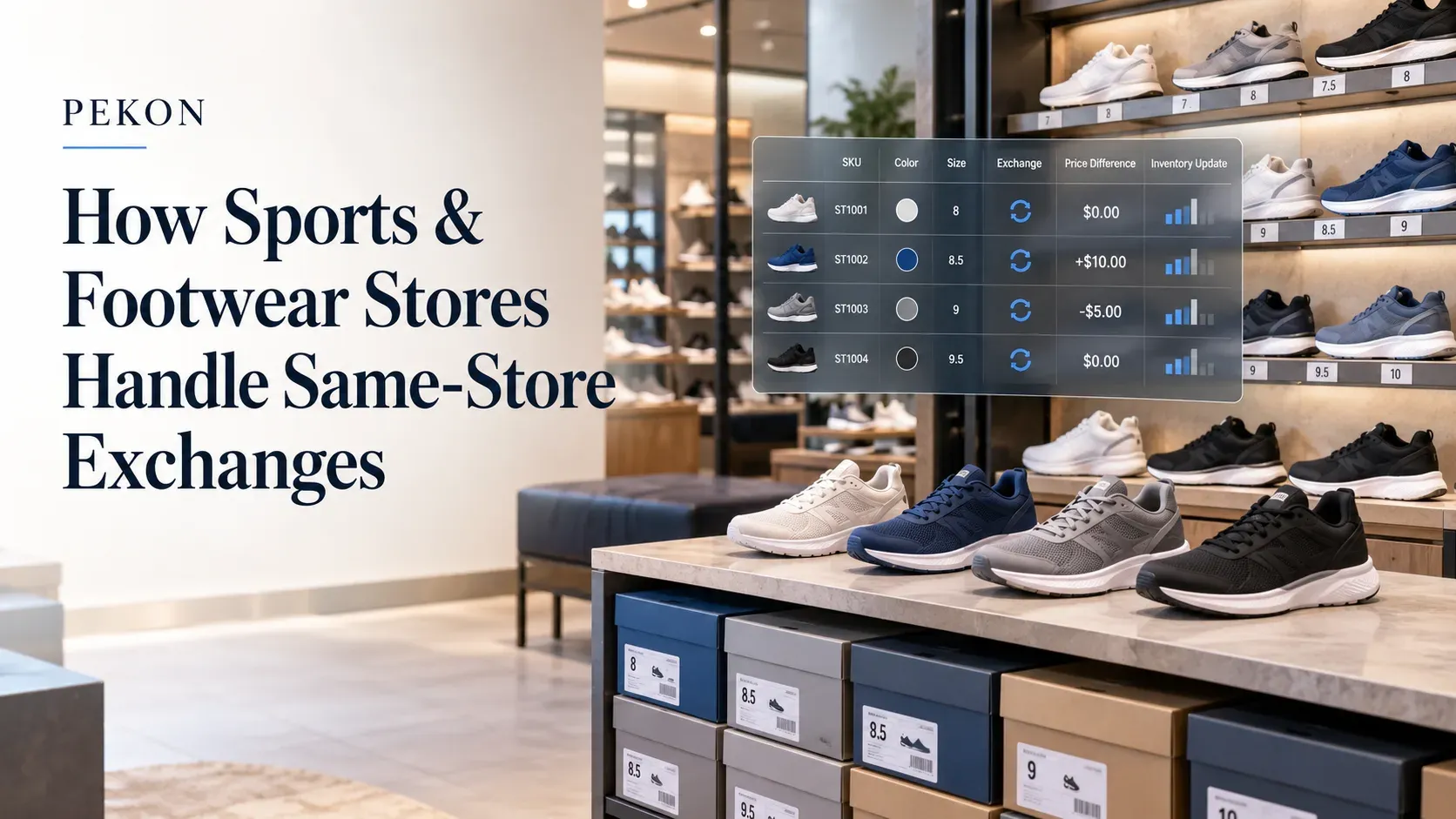
After purchasing sports and footwear products, customers may return to the original store because the size does not fit, they prefer another color, or they want to exchange the product for a different style. For the store, this process involves more than accepting one item and handing over another. The original sales order, returned item, replacement item, price difference, inventory, and sales records all need to remain connected.
The PEKON Sports & Footwear Retail System is built around multi-attribute SKUs, store POS, inventory, and transaction records. It supports equal-value exchanges based on the original sales relationship, as well as additional payment when the customer selects a higher-priced item. The process preserves the original order, product, and staff records, providing a consistent data basis for inventory reconciliation, store performance analysis, and after-sales inquiries.
Same-Store Exchanges Start with the Original Sales Order
When processing an exchange, the store first retrieves the customer’s original sales order. The original order contains the transaction date, product details, final transaction amount, promotion allocation, payment result, and sales staff information. These records provide the basis for identifying the product and documenting the exchange result.
After the returned product barcode is scanned, the system checks the product against the relevant line item in the original sales order. The store confirms the style number, color, size, quantity, and transaction details. After inspecting the physical product, the store selects the replacement item requested by the customer and establishes a clear relationship between the returned product and the replacement product.
The value of the original sales order goes beyond proving that the product was sold. It also allows the exchange record to answer several key questions: Which SKU was returned? Which SKU was provided in exchange? Was an additional payment required? How did inventory change? And who handled the exchange?
Style, Color, and Size Must Be Verified at the Specific SKU Level
Sports and footwear products are commonly organized by style number, with specific SKUs created by combining color and size. A black size 42 shoe, a white size 42 shoe, and a black size 43 shoe are three different inventory items. During an exchange, both the returned and replacement products should be recorded at the specific style-color-size SKU level. Recording only the style number or describing the transaction generally as a “same-style exchange” is not sufficient.
For example, if a customer exchanges a black size 42 running shoe for the same style in black size 43, the system should increase the inventory of the black size 42 SKU and reduce the inventory of the black size 43 SKU. If the customer chooses a white size 42 shoe instead, the inventory change will occur between two different color-size SKUs.
Accurate style, color, and size records allow available inventory, size-breakage analysis, store transfers, and stocktaking to remain based on actual inventory conditions.
Equal-Value Exchanges and Higher-Priced Exchanges Should Be Recorded Separately
When the replacement product has the same price as the original product, the store records the returned product and replacement product through an equal-value exchange process. The system preserves both SKUs and their inventory changes, without treating the exchange as a new regular sale unrelated to the original transaction.
When the customer chooses a higher-priced product, the store collects the difference based on the original exchange relationship. For example, if the original product was sold for RMB 699 and the replacement product is sold for RMB 799, the store collects an additional RMB 100. The system records the original product, replacement product, price difference, and payment result, keeping the additional payment connected to both the exchange and the original sales order.
The replacement product’s transaction amount is calculated according to the brand’s current applicable pricing and promotion rules. An equal-value replacement can be completed directly, while a higher-priced replacement requires the customer to pay the difference. The original transaction amount, replacement product price, and additional payment result should be retained separately. This prevents store staff from manually modifying product prices simply to balance the exchange amount.
Returned and Replacement Products Must Update Inventory Together
After receiving the returned product, the store should complete a physical inspection before confirming its inventory status. Products that meet the conditions for resale can be returned to the available inventory of the corresponding SKU. Products with incomplete packaging, visible damage, or a need for further inspection should be placed into the appropriate pending or non-sale status according to the brand’s rules. They should not be added directly to available inventory.
After the replacement product is handed over to the customer, its quantity is deducted from the corresponding style-color-size inventory at the store. As a result, one exchange creates two inventory movements: the original product returns to the store, while the replacement product leaves the store.
The system records the SKU, quantity, operation time, operator, and inventory status, allowing the post-exchange inventory result to be used for future inquiries and stocktaking.
“Received by the store” and “returned to available inventory” are two different statuses. Recording physical receipt, product inspection, and inventory status separately helps prevent exchanged products from returning to saleable inventory before they have been properly checked.
Transaction and Performance Data Should Preserve the Complete Source
An exchange record should reference the original sales order and retain both the original sales staff member and the staff member who handled the exchange. The original sales staff member represents the source of the original transaction, while the handling staff member represents the after-sales operation. These records serve different purposes and should not overwrite one another.
An equal-value exchange mainly changes the product SKU and inventory records. An exchange involving a higher-priced item also creates an additional payment. PEKON records the original sales order, returned product, replacement product, additional payment, and staff information within the same exchange relationship. This provides accurate transaction data for sales reconciliation, store performance analysis, and staff performance calculation.
The specific rules for performance and commission calculation should be determined by each brand’s internal management policies. The responsibility of the retail system is to record the actual business facts accurately and preserve the relationships between the original sale, exchanged products, amounts, and staff members.
Key Exchange Records Supported by PEKON for Sports & Footwear Stores
The PEKON Smart Retail System incorporates sports and footwear store exchanges into daily transaction and inventory management. Key records include:
- Retrieving product and transaction details through the original sales order;
- Identifying the specific SKU formed by the style, color, and size;
- Recording the relationship between the returned and replacement products;
- Supporting equal-value exchanges and additional payment for higher-priced products;
- Updating inventory changes for both returned and replacement products;
- Retaining the sales staff member, handling staff member, operation time, and exchange result;
- Providing transaction data for inventory reconciliation, sales analysis, and performance calculation.
These records ensure that an exchange is not handled as a manual operation disconnected from the original transaction. Instead, it becomes a continuation of the original sales process. The store can complete the customer service process while the brand maintains consistent and traceable product, inventory, and transaction data.
Frequently Asked Questions
Does an exchange of the same style in a different color or size require a new sale?
No. When the replacement product has the same price as the original product, the system records the returned and replacement products through an equal-value exchange process and updates the inventory of the two style-color-size SKUs accordingly.
How does the system handle an exchange for a higher-priced product?
The system preserves the original sales order and exchange relationship, calculates the difference based on the replacement product’s transaction amount, and records the additional payment and payment result.
Does a returned product immediately return to available inventory?
No. Receiving the product at the store does not automatically make it available for sale. The product must first pass a physical inspection and have its inventory status confirmed. Only products that meet the resale conditions are added to the available inventory of the corresponding SKU.
How can sales performance be reconciled after an exchange?
The system retains the original sales staff member, the staff member who handled the exchange, the returned product, the replacement product, and any additional payment. The brand can use these transaction facts for subsequent performance calculations according to its own rules.
For sports and footwear brands reviewing style-color-size management, exchange price differences, and inventory records, you can discuss existing business processes and system requirements with the PEKON consulting team.