
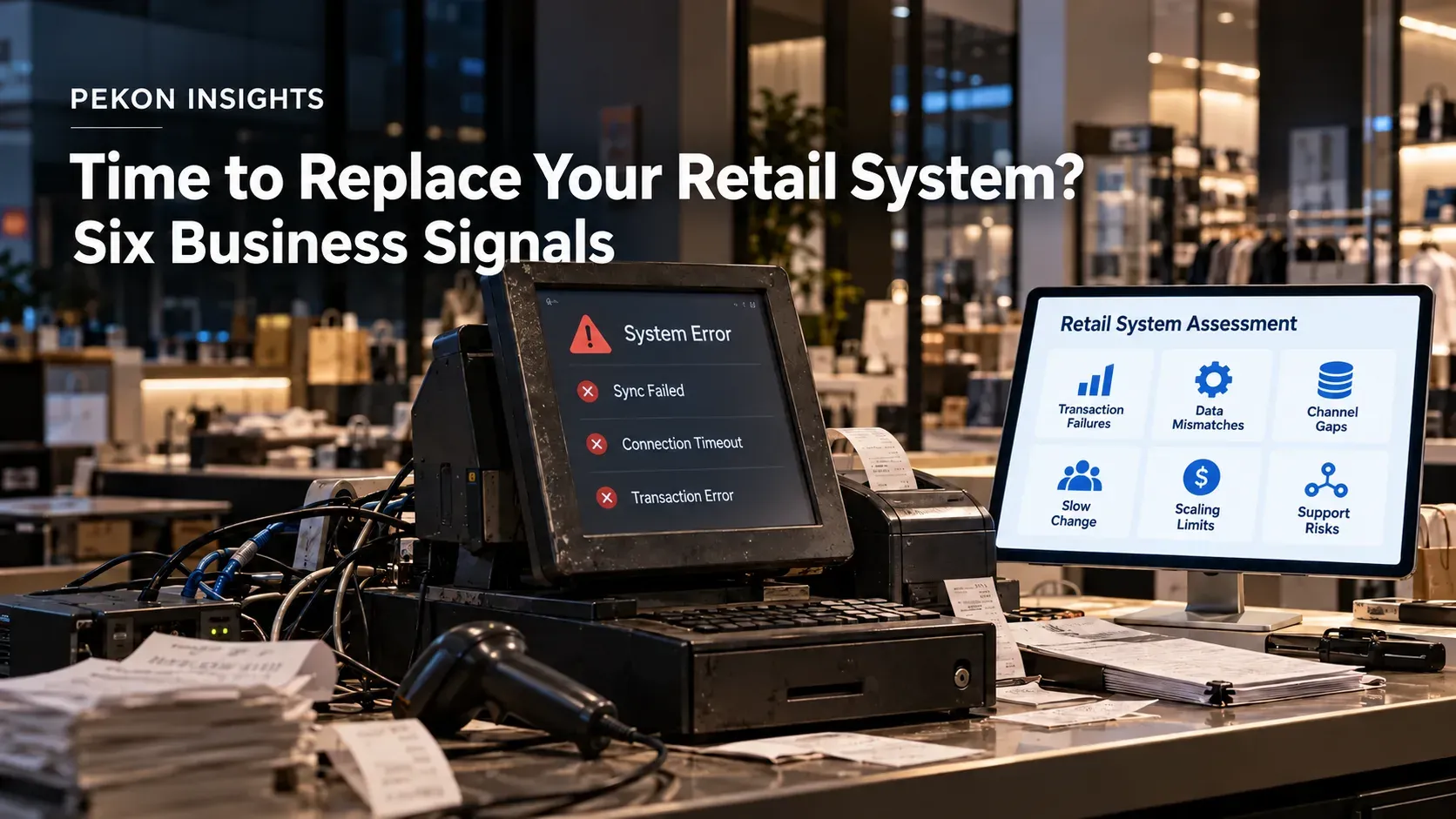
Brands rarely decide to replace a retail system simply because someone notices that the software is old. More often, stores have become accustomed to restarting frozen terminals, finance teams reconcile spreadsheets every day, operations depend on specialists to change promotion rules, and IT keeps interfaces running through patches.
The question is whether the existing system can support the next stage of the business. Age and the ability to produce a sales order provide context, but they do not settle that question. An isolated failure with a known cause, accountable owner and repair deadline may be manageable. Recurring problems across stores and departments, with manual recovery becoming permanent work, warrant a fresh assessment.
1. Core transactions repeatedly fail and recovery depends on manual entry
A retail system must support sales, payments, refunds, customer identification and receipts during trading hours. An occasional device or network fault does not establish the need for replacement. Repeated patterns are more significant:
- Checkouts freeze or orders fail at peak times, leaving customers waiting while staff improvise a manual process.
- Payment succeeds but the sale is not created, requiring transaction-by-transaction investigation by finance and IT.
- Returns, exchanges or loyalty checks depend on a particular terminal or person and cannot be handled across stores.
- After recovery, staff must re-enter orders, adjust stock or amend daily closing records without knowing whether they are creating duplicates.
The cost extends beyond a short queue. Money may be collected without a sales record; a sale may lack its inventory movement; a back-entry may deduct stock twice. Record affected stores, outage duration, orders, recovery steps and subsequent reconciliation work. If interruptions continue and the supplier cannot give a clear repair deadline, begin a formal assessment.
2. Inventory, sales, payments and finance remain out of balance
A small stock discrepancy can result from physical handling, documents in transit or counting cutoffs. Those explanations do not account for persistent differences across systems. Typical symptoms include goods physically present but unavailable for sale, stock recorded but impossible to find, sales without inventory deductions, and cancellations that fail to release reservations. Finance may need to combine sales, returns and payment spreadsheets just to close the day.
Trace the first discrepant document before deciding on the remedy. Is the cause unit conversion, location mapping, transaction status, synchronization timing, a missing message or duplicate posting? An interface repair or process change may solve a clearly isolated problem.
A different response is needed when repeated remediation has failed across several systems, or when stable document links, status histories and reconciliation evidence do not exist. Manual adjustments that merely make totals look consistent undermine the data's value for business decisions. More reports will not repair the underlying records. The assessment must redefine how transactions, inventory, payments and finance are posted, traced and reconciled.
3. Customer identities, benefits and order states differ across channels
Customers do not distinguish the systems behind a store, WeChat mini-program, online shop or livestream channel. They ask why points visible online cannot be used in store, why staff cannot find a mini-program order, or why the same coupon behaves differently across channels.
Recurring manual practices indicate a problem broader than one more missing interface:
- The same customer has several loyalty identities that staff must merge manually.
- Points, tiers and coupons lack consistent records of issue, redemption and reversal.
- Stores cannot see the reservation, cancellation, refund or fulfillment state of online orders.
- Cross-channel after-sales service depends on customer screenshots and headquarters coordinating corrections across teams.
Channels may run on different platforms, but ownership of customer identity, benefits rules, order state and inventory reservations must be explicit. If operations depend on copied data, customer service coordination and retrospective reconciliation, adding interfaces without resolving those responsibilities makes exceptions harder to trace.
4. Campaigns and new services repeatedly miss their launch windows
New promotions, department store payment collection, preorders, limited releases and fulfillment options may require configuration, integration or development. The issue is whether there is a controlled implementation path that can meet the planned trading or campaign date.
Warning signs include requirements raised early without a dependable delivery date, store staff recording transactions manually because the system cannot support the process, and post-campaign spreadsheets used to reconstruct points, stock and sales. A new rule that complicates future upgrades adds another cost.
Review the initiatives delayed or abandoned over the past year. Missing a major campaign window, cancelling a fulfillment option or avoiding cross-store benefits because reconciliation would be too difficult reveals costs that a development-fee comparison misses. The system's limits may be shaping the business before a requirement ever reaches the implementation backlog.
5. Expansion overwhelms permissions, configuration and reporting
At a small scale, experienced staff can compensate for weak controls. Growth requires headquarters to standardize products and prices while retaining justified regional, format or brand differences. Group management needs consolidated information; regional managers should see their own scope; store users should act only within their responsibilities.
When the system cannot model those relationships, each new store requires extensive manual configuration copying. Promotion versions diverge, permissions expand unnecessarily, and access is difficult to remove after transfers or departures. Group reporting depends on regional spreadsheets. Adding a brand or legal entity may require another isolated system.
These symptoms can reflect an organizational, permissions or data model that no longer fits the business. Assess suitability for the next stage of growth before opening additional stores, rather than relying indefinitely on closer supervision of manual work.
6. Maintenance and supplier support have become operational risks
Some legacy systems remain functional but are too fragile to change confidently. Upgrades have been deferred for years because they conflict with historical customizations. Interfaces are understood by only a few people, with incomplete documentation and no adequate test environment. A minor rule change requires coordinated edits across store software, the back office and several connected systems. Repeated incidents receive temporary workarounds instead of a credible repair plan.
A key employee's departure, an external platform's interface change, or the end of support for an operating system or database can turn a deferred problem into an urgent migration. Avoiding replacement expenditure may leave the business carrying increasing uncertainty.
Contract renewal, a price increase or a change of account manager does not alone justify replacement. The stronger signal is the absence of an executable upgrade roadmap, verifiable service commitments and sustainable support, while every maintenance change makes the next change harder.
When to formally assess whether to replace a retail system
Repeated failures affecting collections, refunds, core transactions or payment integrity, without a clear resolution deadline, justify immediate assessment. Persistent cross-department problems also warrant review when manual recovery has become routine and the supplier cannot offer a stable upgrade path. There is no universal number of signals that must be present.
PEKON's published case study of an unnamed leading luxury brand illustrates why early planning matters. The previous POS had been in use for more than 20 years. Historical data migration, parallel operation and repeated rehearsals supported the switch across more than 300 stores while trading continued. This is a specific published project, not a universal delivery commitment. For a large estate with extensive history and complex interfaces, migration, validation, cutover and store support need one coordinated plan before the old system becomes unusable.
Compare repair, partial replacement and full renewal
Starting an assessment does not mean switching the old system off immediately. Match the response to the scope and root cause of the problem.
| Approach | When it fits | Evidence to require |
|---|---|---|
| Continue repairing | An isolated issue with a clear cause that does not undermine the core data model or upgrades | Owner, deadline, regression scope and agreed response if it recurs |
| Replace one layer or redefine responsibilities | ERP or other back-office systems remain suitable, while store transactions, order coordination or loyalty repeatedly fail | System ownership, master data sources, interface timing, exception recovery and reconciliation |
| Full renewal | Multiple problems span transactions, inventory, loyalty and organizational control, and changes disturb extensive historical customization | Target scope, migration data, phased cutover, rollback conditions and long-term upgrade roadmap |
International and group brands with global platforms need an additional distinction. Does the China operation need a few local adaptations, or do critical operating processes depend permanently on peripheral patches? Define the responsibilities of the global platform and the local execution layer before setting the replacement scope.
Turn business signals into evidence before approving a project
Discussions often stall between “it is difficult to use” from the business and “it still runs” from IT. Review three to six months of incidents, reconciliations and manual recovery, including at least one month-end, major campaign or store opening. Use a shared evidence table:
| Record | What to capture |
|---|---|
| Issue and frequency | What happened, how often, and whether it clusters around campaigns, closing or new openings |
| Impact | Affected stores, channels, roles, orders and customers |
| Current workaround | Extra manual steps for stores, operations, finance and IT |
| Actual cost | Trading interruption, refunds, stock adjustments, reconciliation hours, delayed initiatives and service charges |
| Repair path | Known root cause and a supplier-defined scope, schedule, cost and acceptance outcome |
| Acceptance evidence | Documents, logs, reconciliation results or live scenarios that prove the repair works |
Total ticket counts are a poor substitute for this analysis. One recurring failure may matter more than ten small issues already resolved. A problem requiring permanent work by four departments is more significant than an inconvenient screen layout. Business, IT and finance should evaluate the same evidence together.
Before vendor selection, prepare the current system and interface map, high-risk workflows, customizations still in use, migration objects and acceptance scripts. Generic demonstrations cannot compensate for an unclear account of the old system's problems or the new system's required outcomes. Supplier screening should establish scope, deployment, integration and support. Once the direction is chosen, plan data cleanup, pilots, parallel operation, cutover and rollback.
Test candidates with real operational exceptions
The PEKON Smart Retail System covers store transactions, products and promotions, orders, inventory, loyalty and store operations, with project-scoped coordination with ERP, OMS, WMS and other systems. During selection, classify each requirement as standard functionality, configuration, integration, custom development or unsupported. Neither a product name nor a solution description proves how a particular legacy problem will be resolved.
Ask candidates to handle the brand's own high-risk cases: payment succeeds but sales order creation fails; an online order is cancelled and its reservation must be released; a customer returns an order created under an old promotion; or a store loses connectivity and later synchronizes. Acceptance should establish traceability, reconciliation and recovery after the exception, not just completion of the normal transaction.
If the appropriate replacement scope remains unclear, use the current system boundaries, representative failures and expected business changes over the next two years to structure a discussion. Decide the evaluation scope before committing to formal selection.
FAQ
Does an old retail system always need replacing?
No. Age is context. A stable system with reliable data, a clear path for business changes and sustainable supplier support can remain in use. Persistent operational constraints without a credible repair path provide a stronger basis for replacement.
How many signals justify an assessment?
There is no fixed threshold. One recurring unresolved problem affecting payment, fulfillment or payment integrity can be enough. Several signals together suggest a broader mismatch rather than an isolated fault.
Can a brand replace only its store POS and keep ERP?
Yes, provided responsibilities for products, prices, transactions, inventory, loyalty and orders are defined. Agree interface timing, retries, duplicate handling and reconciliation. The right scope depends on root causes and system boundaries.
Is early assessment wasteful if the old system still works?
Assessment does not require immediate procurement. It creates time to collect evidence, define scope and prepare migration before a failure, contract deadline or major campaign forces a rushed decision.
Which replacement costs are most often underestimated?
Beyond software and implementation, include data cleanup, rebuilt interfaces, device and network adaptation, store training, parallel operation, cutover support and rollback. Extensive customization and unclear data ownership increase this work, so include it before selection.