
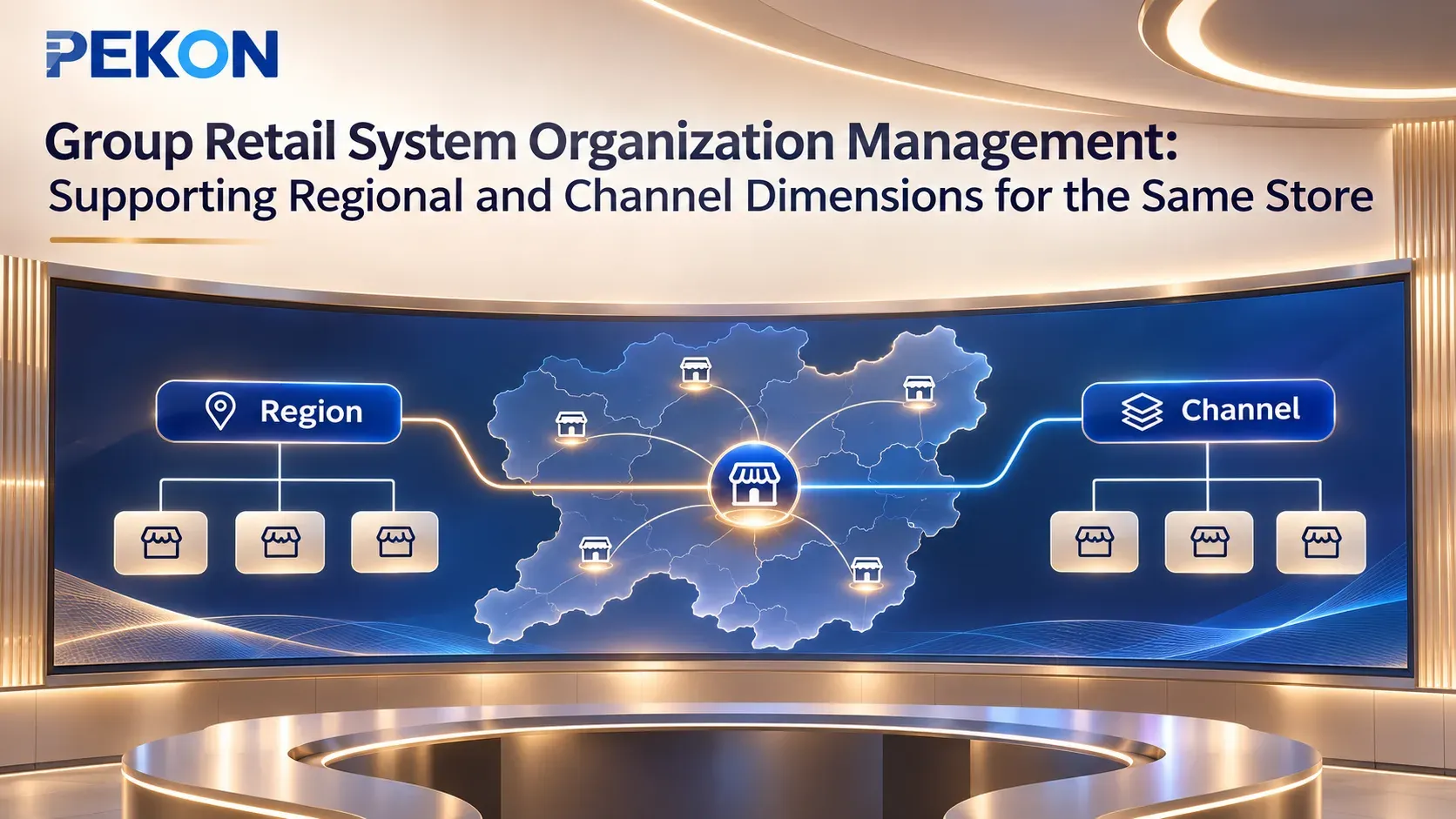
Group Retail System Organization Management: Supporting Regional and Channel Dimensions for the Same Store
Daily operations at a department-store counter may be managed by a regional manager, while shopping-mall activities are coordinated by the department-store channel team. A group brand may therefore need to manage stores and review operating data by both region and channel.
PEKON Smart Retail System supports channel ownership and organizational relationships under different functions within the same store record. When a store changes regions, the regional relationship can be updated while its original channel relationship is retained.
Organizing Stores by Region and Channel
The following is a simplified example:
| Management dimension | Group | Related stores |
|---|---|---|
| Region | East China Region 1 | Hangzhou Department Store, Suzhou Shopping Mall |
| Region | East China Region 2 | Nanjing Department Store, Shanghai Shopping Mall |
| Channel | Department stores | Hangzhou Department Store, Nanjing Department Store |
| Channel | Shopping malls | Suzhou Shopping Mall, Shanghai Shopping Mall |
Hangzhou Department Store belongs to East China Region 1 and is also included in the department-store channel. The regional manager can arrange store visits and follow up on store operations, while the department-store channel team can review authorized operating data across regions and coordinate shopping-mall business.
Configuring Channel Categories and Organizational Functions
If the brand only needs to analyze operations by channel, it can maintain the store’s channel ownership in the store record for reports that support channel-based classification or filtering.
When a channel has its own management hierarchy, the brand can configure the relevant organizational function and assign an upper-level unit under that function to each store. Regional and channel hierarchies can be maintained separately, while reports and business modules reference them according to the project configuration.
For example, regional operating reports can be aggregated according to regional relationships, while department-store channel analysis can be reviewed by channel category. If a process requires approval by a channel manager, the responsible-person rules for the relevant module must also be configured.
For related platform planning, see How Group Brands Can Preserve Brand Differences on a Unified Retail Foundation.
Managing Regional Transfers and Business Handovers
When Hangzhou Department Store moves from East China Region 1 to Region 2, the brand can retain the original store record and update only the regional relationship. Its department-store channel ownership remains unchanged. The manager of Region 2 takes over regional operations, while the channel team continues to coordinate shopping-mall activities.
During the handover, the brand should confirm the effective date and the owners of unfinished tasks, and update the data scope of relevant employees. Whether historical sales are displayed according to the organization at the time of transaction or the current organization should be determined by the purpose of the report and the capabilities of the system.
After the change, the brand should check store ownership in reports, aggregation results and the data visibility of user accounts.
How PEKON Supports Multidimensional Organization Management
PEKON Smart Retail System supports channel hierarchies and organizational functions. A store unit can maintain its channel ownership, associate multiple organizational functions and assign an upper-level unit under each function to form separate functional trees.
During implementation, organizational relationships are configured according to the group’s management responsibilities. The project team confirms how reports, approvals and other modules reference these relationships, and verifies user data permissions. The actual scope of support is determined by the product version and project requirements.
For regional restructuring, channel expansion or organization changes, contact PEKON for a solution discussion.