
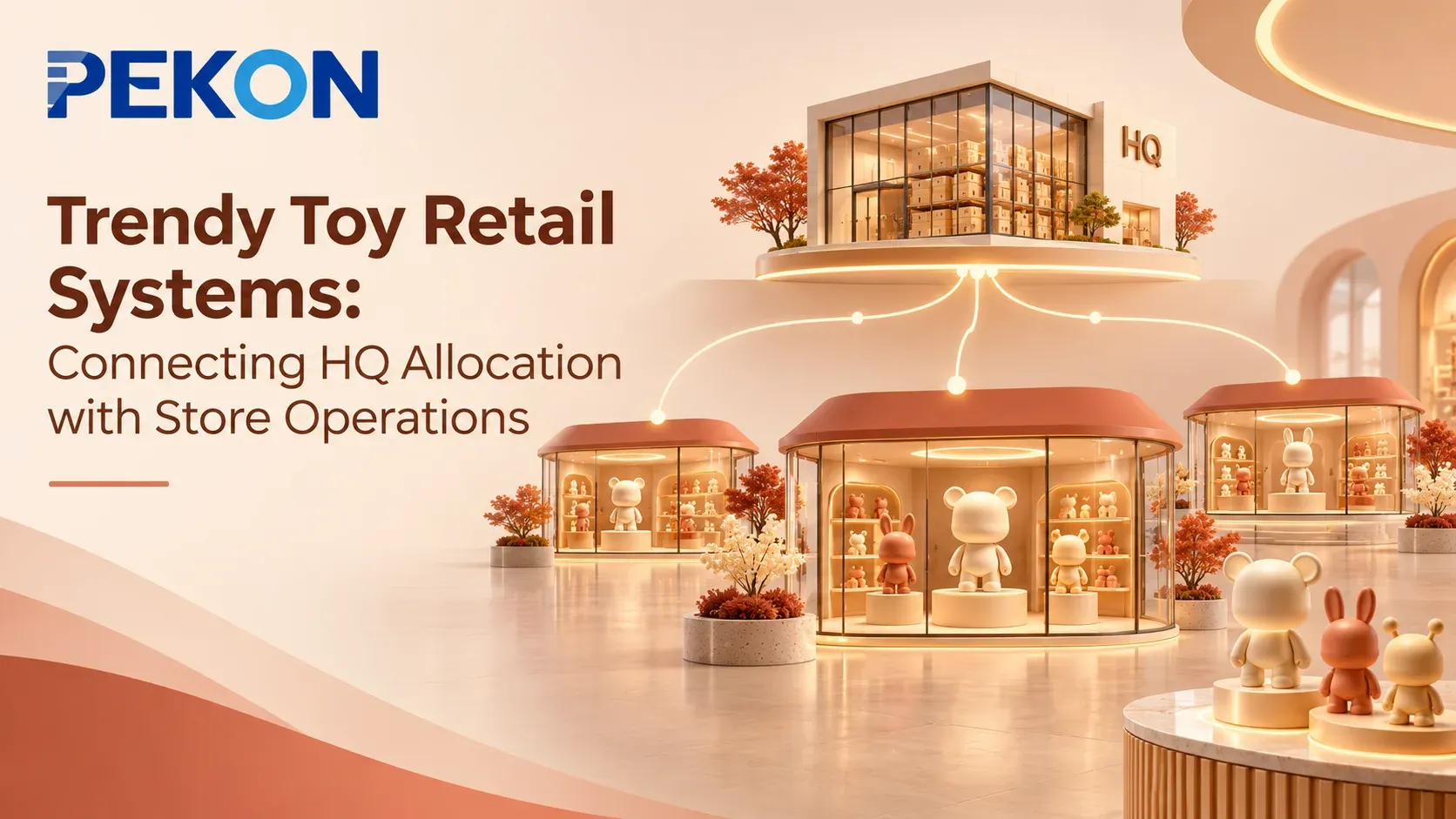
Trendy Toy Retail Systems: Connecting HQ Allocation with Store Operations
Trendy toy products are launched quickly and often involve frequent SKU changes, making headquarters-led allocation an important part of brand operations. Headquarters usually coordinates which stores receive new products and how many units each store should receive, while stores provide confirmation and operational feedback. A retail system for trendy toy brands therefore needs to connect channel supply with store operations.
This model differs from one in which each store independently selects products and decides order quantities. Headquarters must control the launch and supply schedule while also understanding how products perform after arriving at stores, so that future allocation decisions can be adjusted accordingly.
PEKON uses its Smart Retail System as the foundation for store operations and combines it with the PEKON B2B Ordering Platform to support both company-owned and franchise operations for trendy toy brands. The PEKON B2B Ordering Platform supports product policies, order confirmation and supply follow-up for franchise channels, while the Smart Retail System records store receiving, sales and inventory within the connected management scope, providing operational data for future HQ allocation.
HQ-led allocation with different permissions for company-owned and franchise stores
Frequent product launches mean that stores must continue receiving new products, while headquarters needs to allocate inventory according to supply availability, launch schedules and store conditions. When limited-edition products or initial inventory are restricted, allocation also affects channel coverage and the timing of store launches.
Company-owned stores generally follow HQ allocation instructions. They may provide feedback on SKUs they do not need or adjust quantities within an authorized scope, but they do not independently decide the quantity of every SKU. Store feedback supplements local operating information and helps headquarters correct unsuitable allocation plans.
Franchise stores usually have greater operating autonomy. Headquarters provides supply recommendations, and franchisees confirm or adjust products and quantities according to their own conditions before finalizing the supply arrangement with HQ. Greater autonomy does not change the overall allocation-led operating model.
Trendy toy channel management therefore needs to maintain HQ control over products and supply schedules while preserving the feedback and confirmation space required by both types of stores.
B2B ordering: Turning franchise supply policies into orders
Franchisees are located in different regions and may be subject to different product ranges, price lists and supply policies. The PEKON B2B Ordering Platform supports channel products, price lists, order review and progress tracking, helping brands apply these policies to specific channel customers.
Based on the HQ supply recommendation, franchisees need to see which products are included in the current batch, which prices apply and how many units will ultimately be supplied. The brand also needs to distinguish between the quantities requested by a franchisee and the quantities that have already been confirmed, reducing repeated communication and manual consolidation.
For limited-edition products, opening an order window does not mean that every requested unit will be fulfilled. For split deliveries, a confirmed quantity does not mean that the products have already been shipped. Clear order and supply records allow headquarters and franchisees to track progress around the same business transaction.
The PEKON B2B Ordering Platform provides a product foundation for this type of channel operation. The specific process for issuing HQ recommendations and obtaining franchise confirmation can be implemented according to the brand’s management model.
Smart retail systems: Giving HQ visibility into store-level performance
The quantity shipped by headquarters reflects supply execution. The quantity actually sold by a store and the inventory that remains provide a more direct view of product performance at the retail end.
The Smart Retail System connects receiving, sales, returns and inventory records for stores within the management scope. This allows headquarters to evaluate future supply based on actual store operations. A newly launched product that is selling quickly after arrival requires a different response from a product that is still in transit or has not yet been received.
Trendy toy products may also be supplied by case but sold by individual box or unit. Product and quantity definitions must be standardized before HQ supply data and store sell-through data can be viewed together. Otherwise, shipped quantity may be mistakenly treated as sales quantity.
For franchise stores operating on independent systems, the availability of store-level operating data depends on the actual integration scope. Channel orders alone cannot replace store sales and inventory records.
From supply planning to the next product allocation cycle
The PEKON B2B Ordering Platform and the Smart Retail System connect channel supply and store operations respectively. Their combined value is to help headquarters implement channel policies, follow up on supply execution and understand product performance after arrival, within the scope of available store data.
For trendy toy brands with frequent product launches, this information supports the next allocation cycle: which stores have received the products, which products are selling quickly, which products still have inventory, and whether channel feedback is consistent with actual store performance.
Based on its established retail and B2B products, PEKON works with each brand’s company-owned and franchise structure and existing systems to build the required supply and store management capabilities. This allows HQ coordination and channel autonomy to operate within the same business framework.
Learn more about the PEKON Smart Retail System and the Trendy Toy Retail Solution, or contact PEKON to discuss HQ allocation, franchise supply and store operations.