
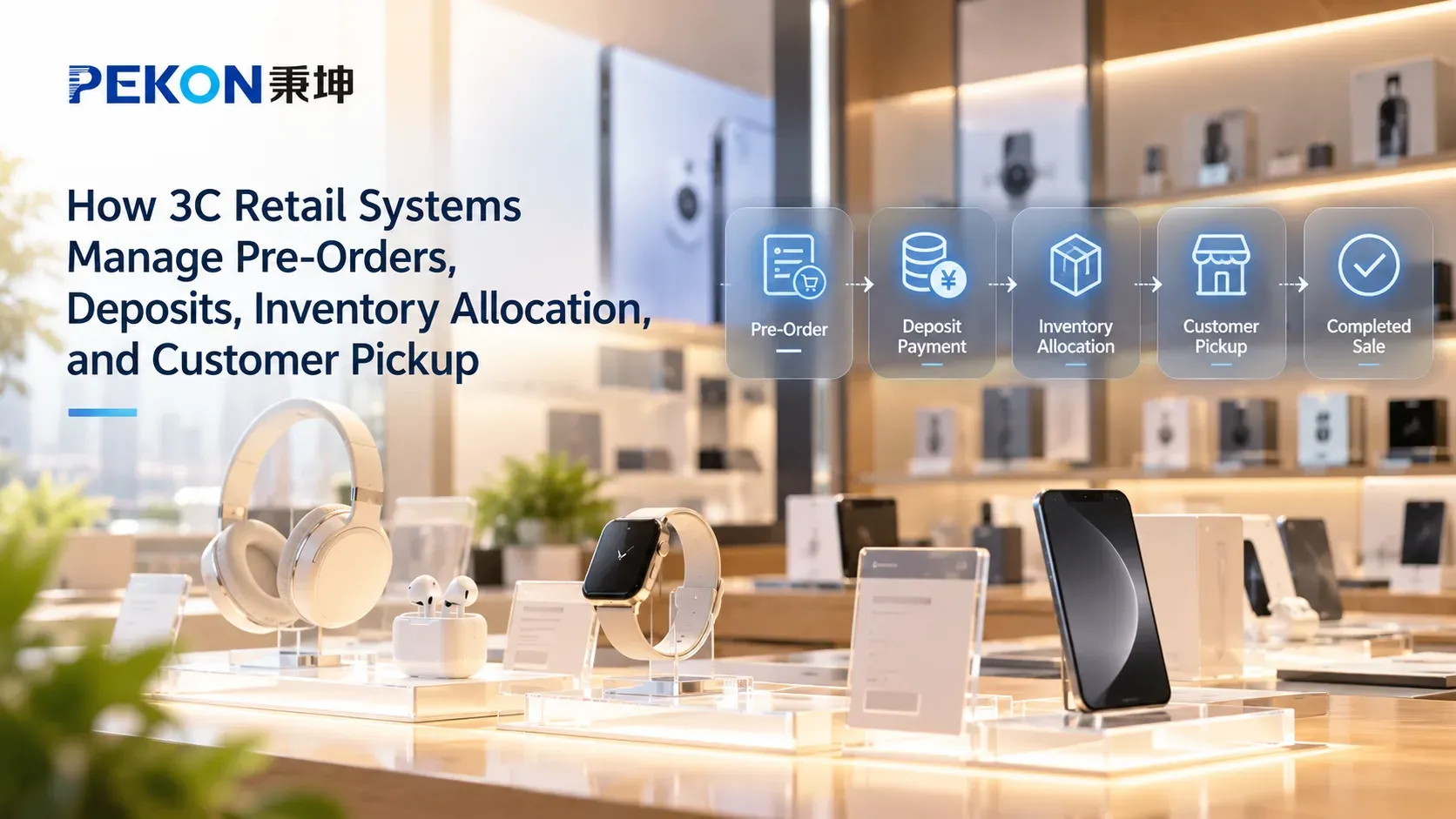
How 3C Retail Systems Manage Pre-Orders, Deposits, Inventory Allocation, and Customer Pickup
When customers make an advance payment during a new product launch, the brand accepts an order that has yet to be fulfilled. The physical device has not been delivered. Effective pre-order management for consumer electronics requires the original order to connect advance payments, product arrivals, remaining balance payments, and customer pickup, ultimately generating a completed sales record when the device is handed over.
If a store immediately treats an advance payment as a completed sale and creates a separate transaction when the product arrives, the relationships between the customer, product, payment, and delivered device may be lost. The brand may struggle to determine how many orders remain unfulfilled, while also facing risks such as duplicate payment records, overlapping inventory commitments, or sales records that cannot be traced to the serial number (SN) of the actual device delivered.
The PEKON 3C Retail System Solution connects device sales, unique product identifiers, store inventory, and after-sales service records. PEKON supports product reservations, advance payments, balance collection, customer pickup, and unique device identification. New product pre-order workflows can build on these existing capabilities to connect orders with physical device delivery. Whether serial numbers can be assigned to pre-orders before pickup depends on the product version and project scope.
1. Create Pre-Orders and Link Advance Payments to Specific Products
Before launching a pre-order campaign, a brand needs to define the eligible products, participating stores, pre-order prices, campaign start and end dates, pickup availability dates, and advance payment rules.
Customers place pre-orders during the designated campaign period and pay the required amount. Once the products arrive, the orders proceed through device allocation, remaining balance payment, and customer pickup.
A reservation made for an individual customer because an item is temporarily out of stock is a different business scenario. Such backorders do not necessarily follow the rules of a new product pre-order campaign.
The retail system links each advance payment to the original pre-order and its corresponding order line, recording the amount, payment method, payment result, and transaction time.
Store employees can check the amount already collected and the outstanding balance, while finance teams can trace each payment back to its original business transaction.
The advance payment does not automatically become a completed retail sale. A corresponding completed sales record is generated when the product is actually delivered.
Distinguishing Deposits from Advance Payments
In retail operations, terms such as deposits, reservation payments, and advance payments may be used differently. Their legal and accounting implications are not necessarily the same.
Brands should clearly specify the nature of the payment, how it will be applied to the final purchase price, and the applicable refund conditions in customer agreements and campaign terms.
The retail system records payment amounts, transaction results, related orders, and subsequent processing activities. It does not determine contractual terms on behalf of the brand.
Where a payment legally constitutes an earnest-money deposit under Chinese law, the brand should also consider Articles 586 and 587 of the Civil Code of the People's Republic of China, which address deposit amounts, their application toward the purchase price, and consequences of contractual breach.
Order status and payment status should be recorded separately.
A pre-order may progress through stages such as:
- Created
- Advance payment received
- Awaiting product arrival
- Ready for pickup
- Completed
- Canceled
- Overdue
Payment records separately track advance payments, outstanding balances, and refunds.
The specific status definitions and transition conditions should follow the brand's pre-order policies. The original order number should remain associated with subsequent pickup activities and completed sales records.
2. Match Pre-Orders with Inventory and Device Serial Numbers After Product Arrival
When a customer first places a pre-order, the store may not yet have a physical unit available for delivery. At this stage, the order is associated with the product SKU, model, and specifications.
After the products arrive and receiving procedures are completed, the system records the quantities received.
For devices managed through unique identifiers, receiving records also retain the corresponding serial numbers (SNs). PEKON uses unique device identifiers in business processes such as receiving, sales, returns, and stocktaking.
Allocate Available Inventory to Pre-Orders
When incoming inventory is insufficient to fulfill all outstanding pre-orders, the brand must first establish fulfillment priorities.
PEKON's existing standard capabilities allow configuration of whether pre-orders reserve inventory.
Automated prioritization based on order placement time, advance payment status, membership tier, or customer confirmation requires verification against the relevant product version and project scope.
Where automated allocation rules are not enabled, authorized employees allocate inventory according to the brand's policies, while the system retains allocation results and operation records.
Determine When Serial Numbers Are Assigned
There are two possible approaches to associating physical devices with pre-orders.
Option A: Allocate Specific Serial Numbers Before Pickup
If the project supports advance assignment of unique device identifiers, a store can associate an individual device's SN with an eligible pre-order and update that device's available inventory status accordingly.
Option B: Reserve Inventory by SKU and Capture the SN at Pickup
If the standard product captures serial numbers only during completed sales transactions, the store can initially reserve inventory at the SKU quantity level.
The employee then scans the actual device's serial number when it is handed over to the customer.
The appropriate approach depends on the product version and implementation scope.
For additional information about how device identifiers connect receiving, sales, and subsequent business records, see 3C Retail System Selection: Flagship Store POS, Unique Device Identification, and After-Sales Registration.
3. Collect the Remaining Balance and Generate the Final Sales Record at Pickup
When a customer arrives to collect a pre-ordered device, store employees retrieve the original order using the order number, customer information, or pickup credentials.
They then verify:
- The pre-ordered product and specifications
- The advance payment already received
- The outstanding balance
- The physical device available for delivery
The remaining balance payment should be recorded against the original pre-order rather than entered as an unrelated transaction.
If the brand permits price adjustments, promotional changes, or modifications to accessory bundles at pickup, the applicable conditions and payment differences should follow the pre-order policy, with the changes recorded.
From Pre-Order to Completed Sale
Within PEKON's existing reservation workflow, stores can create orders for out-of-stock products and collect either full payment or a partial advance payment.
Once the products arrive, the store can collect the remaining balance and complete pickup.
Reporting distinguishes outstanding pre-orders from completed sales orders.
How advance payments, completed sales, and related documents are synchronized with ERP or financial systems depends on the brand's existing architecture and project integration scope.
Once the remaining payment has been completed and physical delivery is confirmed, the system generates the completed sales record.
If a serial number was assigned during the pre-order stage, the completed sales record carries forward that device information.
If inventory was reserved only at the SKU level, the employee scans the serial number of the actual device delivered at pickup.
The resulting sales record connects the original pre-order with:
- Advance and remaining balance payments
- The selling store
- The pickup date and time
- The serial number of the device actually delivered
After pickup, the POS retains the device, transaction, and delivery records.
PEKON can also support store-level registration of repair and extended warranty transactions and connect with a brand's specialized after-sales service system according to the agreed project scope.
Responsibility for device activation, warranty commencement, and physical repair processing must be determined based on the brand's existing systems and operating model.
4. Define What Each Business Record Should Contain
Pre-order fulfillment involves events occurring at different stages.
Pre-orders, payments, store inventory, and completed sales should each maintain their own records and statuses while remaining connected through the original order number, order lines, and device serial numbers.
| Business Record | Primary Question | Relationship with Other Records |
|---|---|---|
| Pre-order | What did the customer order, where will pickup take place, and what is the fulfillment status? | Links advance payment, product arrival, remaining balance, and completed sale |
| Advance and balance payment records | How much has been collected, through which payment method, and has any refund occurred? | Linked to the original pre-order rather than reconciled independently |
| Store inventory and serial numbers | Which products have arrived, what inventory is reserved, and which device is actually delivered? | Linked to the order during pre-allocation or completed sales, depending on implementation |
| Completed sales record | What was delivered, what was the final transaction amount, and which device was sold? | Carries forward the original pre-order and references payments and the final serial number |
Each record serves a distinct purpose.
The pre-order records outstanding fulfillment quantities and progress. Inventory records confirm whether products have arrived and whether they are reserved. Payment records show whether the required amounts have been collected. The completed sales record confirms the final delivery.
When an exception occurs, the brand can identify whether an order is awaiting product arrival, device allocation, remaining balance payment, or customer pickup.
5. Handle Overdue Pickups According to Brand Policies
Pre-orders should record the agreed pickup deadline and relevant customer notifications.
Exceeding the pickup deadline does not automatically mean an order has been canceled. Similarly, an advance payment should not automatically become non-refundable without a contractual or campaign-rule basis.
Before launching a pre-order campaign, brands should define the conditions governing:
- Pickup extensions
- Order cancellation
- Payment refunds
- Inventory reservation release
These conditions should be communicated consistently when customers place their orders.
The retail system records the results of actions taken under the established rules.
For example, it should retain whether an order has become overdue, whether reserved SKU quantities or specific devices remain allocated or are released back to available inventory, whether the advance payment has been refunded, and whether the order has been closed or returned to active fulfillment.
Where an extension is permitted, the revised pickup deadline and relevant operation records should also be retained.
Inventory and payment adjustments must remain linked to the original pre-order. This helps avoid situations in which inventory has already been released and resold while the original order still appears to be awaiting pickup.
Whether overdue conditions trigger automated actions, require approvals, or generate customer notifications depends on the brand's policies, product version, and division of system responsibilities.
The payment channel responsible for processing refunds must also be established.
PEKON records retail-side orders, inventory, payments, and processing results. The brand remains responsible for defining the legal and commercial terms applicable to deposits and advance payments.
6. Maintain Order Continuity Through Final Device Delivery
PEKON uses pre-orders to record customers, products, and advance payments; inventory records to track product arrivals, reservations, and individual devices; and completed sales records to confirm final delivery.
Through the original order relationship, brands can trace payments, device serial numbers, and pickup outcomes.
They can also identify whether fulfillment is delayed at the product arrival, device allocation, balance payment, or customer pickup stage.
During project planning, brands should explicitly define requirements for inventory allocation priorities, advance serial number assignment, overdue reservation release, customer notifications, and integration with surrounding systems.
Each requirement should be classified as one of the following:
- Standard product functionality
- Parameter configuration
- System integration
- Custom development
- Currently unsupported
Existing reservation, payment collection, pickup, and unique device identification capabilities should be used within the applicable product scope.
Any allocation rules dependent on specific product versions should be validated before go-live.
For a related example of unique device identification, store orders, warehouse fulfillment, and after-sales records working together, see PEKON's International Premium Consumer Device Brand Retail Case.
This case illustrates the coordination of device identity and order fulfillment. It does not describe a new product pre-order implementation.
Brands comparing the capabilities of existing and replacement retail platforms can also explore PEKON's Retail System Selection and Replacement Topic.
If your brand is planning new product pre-orders, incoming inventory allocation, remaining balance collection, or in-store pickup workflows, contact PEKON to assess the appropriate solution scope based on your product portfolio, order processes, inventory operations, and existing system architecture.