
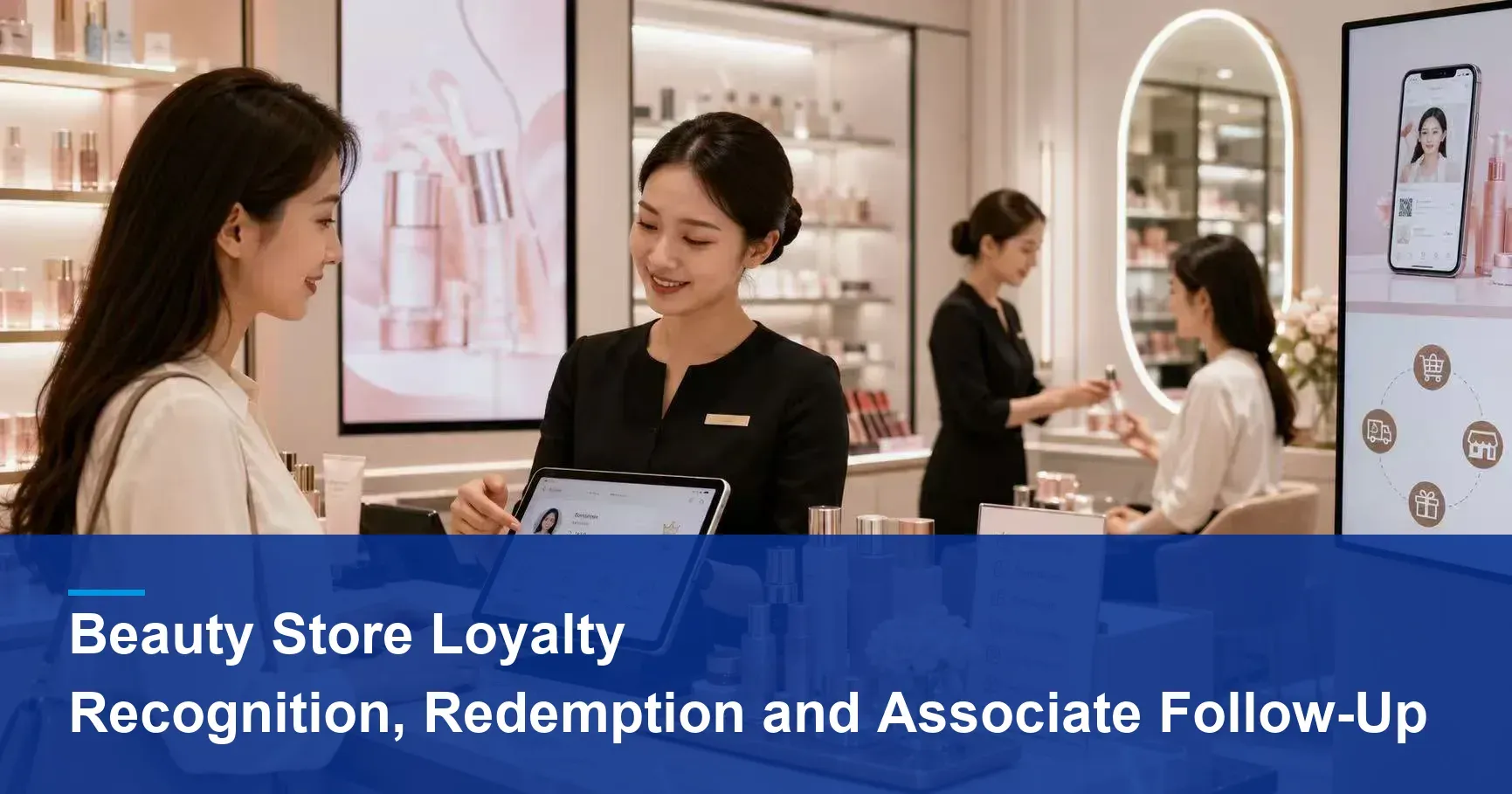
Beauty Store Loyalty: Member Recognition, Benefit Redemption and Associate Follow-Up
Beauty store loyalty is a coordinated workflow. CRM manages identities, tiers, points, coupons, tags and membership rules. POS applies them during transactions and returns. Associate tools record consultations and support follow-up. Together, they turn recognition, service, sales and later contact into reusable customer information.
A brand may already have a member centre, but the experience happens in store: can staff recognise a shopper, explain available benefits, understand relevant preferences and continue service after the visit?
Why CRM alone does not complete the store workflow
Beauty consultations can involve product trials, shades, skin needs, coupons, points, samples and future contact. Fragmented tools create familiar problems: an existing member cannot be found; an online coupon fails in store; a gift is issued without a stock record; a consultation remains in a private chat; or headquarters cannot see whether a follow-up task was completed.
| System | Responsibility |
|---|---|
| CRM | Identity, tiers, points, coupons, tags, audiences and marketing rules |
| POS | Member lookup, promotion calculation, redemption, payment and returns |
| Associate tools | Service records, customer groups, tasks, product sharing and assisted ordering |
| Mini-program | Registration, member codes, benefits, coupons, appointments and online orders |
1. Recognise the customer quickly
A phone number, member code or mini-program can identify a customer. Within the appropriate permissions, staff should see the tier, points, usable coupons, recent purchases and relevant preferences.
Recognition can help before checkout. Existing purchase and shade information reduces repeated questions; a new shopper can register with authorisation and link the consultation and purchase to one profile.
Test cross-store identity, duplicate records, changed phone numbers, update timing and access by headquarters, store and associate role. Agree identity ownership and matching with the existing CRM rather than relying on a single demonstration lookup.
2. Redeem benefits accurately at checkout
Member prices, points discounts, gifts, coupons, birthday rewards and treatment vouchers involve different rules. They must be usable, not merely visible.
The POS should retrieve eligible benefits, calculate discounts against tier, store, product, validity and stacking rules, confirm the customer's selection, then record deductions and the completed transaction.
For example, a member buying serum and foundation may have a coupon and qualify for a gift. The system needs to establish compatibility, allocate discounts, adjust points and coupons, and record gift stock. A later partial return must follow the original order and the brand's refund and benefit-return policies.
Confirm conversion rates, redemption caps, stacking and returns rules. For third-party CRM, define lookup, deduction, retry, duplicate-request and reconciliation responsibilities.
3. Connect redemption with physical or service fulfilment
Birthday gifts need stock movements. Samples may be promotional gifts, membership benefits or testers. Treatments need booking, attendance and completed-service records.
Before issuing a birthday gift, check eligibility, validity and prior collection elsewhere. Record both the redeemed entitlement and gift issue so neither side remains incorrectly available.
Makeup and care services may use vouchers, visit packages or monthly plans. Confirm the booking and staff member, redeem the service after completion and retain the remaining entitlement. Scheduling, revenue recognition, refunds, consumables and staff performance require explicit process ownership.
4. Preserve consultation knowledge appropriately
Transactions show what was bought, but consultations can explain why. Relevant information may include shade preference, desired product effects, trial feedback and reasons for not purchasing.
Configurable tags, options and short notes reduce the burden of long forms. An associate might record the preferred foundation shade after a trial, or a customer's feedback on a serum's texture for the next consultation.
Collect only necessary information with appropriate authorisation. Skin or allergy-related details require purposeful fields, access and retention rules rather than unrestricted note taking.
5. Turn follow-up into manageable tasks
Useful occasions include trial feedback, expected replenishment, coupon expiry, birthdays and a considerate follow-up after a visit without purchase. Personal memory alone makes execution uneven.
WeCom associate tools can turn membership segments and rules into assigned tasks. Staff review relevant history and benefits, contact the customer and record feedback and next steps. Managers can assess completion alongside visits, coupon activity and purchases.
For a replenishment reminder, first check the recent purchase and previous feedback. The appropriate action may be a usage suggestion, a reorder reminder or an invitation to try something new. Return the outcome to the profile to reduce duplicate contact.
6. Make customer service transferable when staff move
The customer relationship belongs to the brand. If preferences and service history remain only in an employee's personal account, a replacement associate cannot maintain continuity.
Keep relevant records within the brand's systems and authorised WeCom environment. Managers can reassign customers and unfinished tasks when employees move or leave, while removing the former user's access.
Define the transfer scope and visibility of historical information. Binding a member account does not mean every chat automatically enters CRM; that depends on platform capability, privacy policy and configuration.
7. Connect headquarters strategy with store feedback
Headquarters defines audiences and policies; stores need to know whom to contact and how to serve them. A traceable chain links selection, task assignment, recognition, service, redemption and feedback.
Useful store measures include member share of sales, second visits by new members, priority-customer follow-up, benefit collection and redemption, and visits or purchases after contact. Choose measures tied to operating objectives rather than adding unnecessary data entry.
When adding marketplaces, mini-programs and WeCom, define CRM ownership to avoid duplicate profiles, coupons and outreach.
8. Demonstrate one complete membership journey
- Identify a test member by phone or code.
- Display the correct tier, points, coupons and relevant history.
- Enter products and test member prices and promotion combinations.
- Redeem points or a coupon and issue a gift.
- Check the order, benefits and gift-stock changes.
- Record a trial or preference and find it in the profile.
- Assign an associate task and record the outcome.
- Process a partial return and reconcile money and benefits.
- Simulate a staff transfer and check reassignment, permissions and logs.
This tests the connections among CRM, POS, inventory and associate tools more effectively than a feature checklist.
Bring customer data into everyday service
PEKON offers POS, CRM, membership mini-programs and WeCom associate capabilities for beauty brands to support private-domain customer engagement. The project should define how these work with existing ERP, OMS or third-party CRM systems. Clear ownership and connected records allow the loyalty programme to become part of each store interaction.
Frequently asked questions
Is store loyalty one application?
It is usually a combination of CRM, POS, associate tools and customer-facing mini-programs.
How can staff recognise members quickly?
Use the agreed phone, code or mini-program identity and validate cross-store matching, duplicate handling and access rights.
How should CRM and POS divide work?
CRM owns member rules and master data; POS applies them in transactions and returns, with clear synchronisation and reconciliation.
Can points and coupons work online and offline?
Yes, when identity and earning, redemption, eligibility, stacking and return rules are connected through the required interfaces.
How are gifts and samples linked to membership?
Validate eligibility, redeem the benefit and record the relevant gift or non-sale stock movement. Tester handling follows the brand's stock model.
How should associates follow up?
Use authorised tasks based on relevant purchase, trial, coupon or segment information, and record results with appropriate contact frequency.
What happens when an associate leaves?
Transfer authorised customer relationships and tasks, preserve necessary history and revoke access under the agreed policy.
Can a third-party CRM remain?
Yes. Define master-data ownership, fields, synchronisation direction, exception handling and reconciliation before implementation.